China conspicuously absent from Ali’s US-led “international coalition” against Venezuela threat
Auguat 25, 2025
China — one of Guyana’s most significant bilateral partners by trade, investment and energy ties — is conspicuously missing from Head of State, President Irfaan Ali’s roll-call of countries, he says are now “with us in defence of our sovereignty,” even as the US moves thousands of sailors and Marines into the southern Caribbean and Georgetown reaffirming support for the operation.
He was at the time addressing a large campaign rally at Stewartville, Region # 3, and was adamant, “…today, in 2025, again, we are fighting to give you the best future that you can ever have.”
Again referencing the “largest international coalition in defence of our sovereignty,” Ali told those in attendance, “..our region is undergoing tremendous changes in its security framework.”
Reiterating, “Venezuela is a threat to our sovereignty,” he told the electorate, “…our country needs leadership you can rely on, leadership you can trust, leadership that will ensure the sovereignty of our country, that will ensure the protection of our country.”
Under the People’s Progressive Party/Civic government, we have mobilised the greatest international coalition in defence of our sovereignty.”
According to President Ali, “whether it’s the Middle East, the Commonwealth, CARICOM, the OAS (Organization of American States), the US, UK, Canada — all of them are with us in defence of our sovereignty… This did not come by accident. This came because of our relentless work… to build international trust, to build international confidence.”
It should be noted that the United States has already deployed an amphibious ready group to the South Caribbean Sea, including the USS Iwo Jima (LHD-7) and accompanying ships, carrying about 4,500 sailors and Marines, alongside destroyers and an attack submarine.
These are said to be part of a wider push, which the US’ administration says targets Venezuelan cartels and arms flows.
Secretary of State Marco Rubio, in making the announcement recently, said, the deployment will “…help counter transnational criminal organizations and foreign agents that threaten the security of the Caribbean and northern South America.”
Guyana has since publicly aligned itself with the US move and over the weekend, issued a statement reaffirming support for a crackdown on Venezuelan criminal networks, highlighting the naval presence in the southern Caribbean.
Neighbouring Trinidad and Tobago and its Government, led by Kamla Bissesar-Persaud, also declared its unflinching support for the US operation and Guyana.
Poignantly, Beijing’s stance on Venezuela and the Essequibo dispute diverges sharply from that of the US.
This, since China maintains close ties with Nicolas Maduro’s government, calls for dialogue over territorial issues, and opposes US military build-ups near Venezuela.
China’s chargé d’affaires stationed in Guyana had earlier this year publicly rebuked US suggestions that Beijing was stoking tensions, insisting that China “has nothing to do” with Guyana–Venezuela and urging a peaceful settlement.”
Guyana’s official position on record is that it deals “with all partners based on mutual respect.”
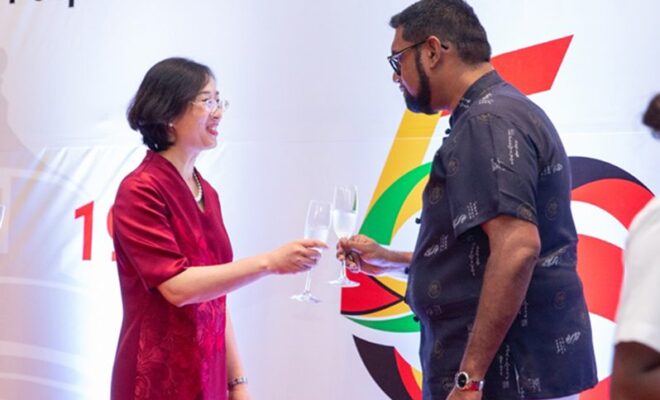
The omission of China from Ali’s coalition list is notable, given the scale of the relationship between the countries that have shared formal diplomatic ties since 1972.
Chinese investment in Guyana has ballooned — with the new ambassador citing a jump from roughly US$256 million in 2019 to over US$10 billion by 2024 and bilateral trade reaching a record US$1.4 billion last year.
China’s state-owned CNOOC also holds a 25 percent stake in the Stabroek Block alongside ExxonMobil and Hess/Chevron — the offshore engine of Guyana’s recent economic boom.
On May 1 last, the International Court of Justice was forced to declare that Venezuela must refrain from conducting or preparing elections in Essequibo.
Notably, the Chinese judge on the Court, Judge Xue, at the time, joined a joint dissent with Judges Bhandari and Nolte on aspects of the ruling.
Against that geopolitical backdrop — and with US warships off the coast — Ali was adamant, “Our partners know they can rely on us for the rule of law. They can rely on us for democracy, and they can rely on us to stand up for what is right.”
Addressing voters directly, he said, “…compare that to the others. One step, the world has to fight to ensure democracy