State expected to seek bail revocation for Azruddin Mohamed in extradition case following remand over Cybercrime charge
October 31 2026
The prosecution in the ongoing extradition proceedings against Leader of the Opposition, Azruddin Mohamed, is anticipated to formally apply for the revocation of his bail when court resumes on today at 9am.
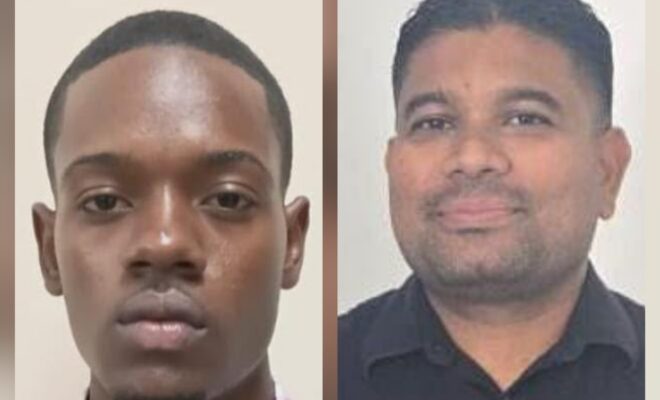
The anticipated move by the state follows Mohamed’s remand to prison on Friday, October 30, 2026, alongside 20-year-old Police Constable Ryan Greene.
The two men were jointly charged at the Sparendaam Magistrate’s Court with the unauthorized giving of electronic data under Section 9 of the Cybercrime Act No. 16 of 2018.
While the state previously sought bail revocation before Chief Magistrate Judy Latchman based on unproven police inquiries surrounding a drone incident, a request the Chief Magistrate dismissed due to a lack of evidentiary basis, the prosecution is now expected to rely on Mohamed’s new charge and remand status to argue that he has engaged in subsequent offending while on pre-trial release.
If the prosecution formally applies for revocation on Monday, its arguments may center on Section 7 of the Bail Act 2022 (No. 21 of 2022), which sets out the legal framework under which pre-trial liberty may be refused or revoked. Under Section 7(1) of the Act, a court may refuse or revoke bail if satisfied that there are substantial grounds to believe the defendant, if kept on release, is likely to fail to surrender to custody or fail to appear before a court as required, commit an offense while on bail (other than an offense punishable solely by a fine) or interfere with witnesses, tamper with evidence, or otherwise obstruct the course of justice in relation to the defendant or any other person. Bail may also be refused or revoked where, custody is deemed necessary for the defendant’s own protection or for the preservation of public order, the defendant, having been released on bail, has committed an act constituting a risk under paragraph (a) or breached any condition imposed upon release, the defendant is charged or is likely to be charged with a serious offense, substantial grounds suggest the defendant provided false or misleading identity or address details, or lacks a fixed place of abode, whether the case is adjourned for inquiries or report, and completing those inquiries is impracticable without keeping the defendant in custody, or even if time constraints have prevented the court from obtaining sufficient information to make a determination since the institution of proceedings. Section 7(2) further mandates that in evaluating any application to refuse or revoke bail, the court must weigh the interests of society against the defendant’s constitutional right to personal liberty and potential prejudice caused by detention.
The court must consider all relevant circumstances, including, the length of time already spent in custody since arrest, the nature and gravity of the offense charged (or likely to be charged) and the severity of the potential penalty, the character, associations, financial means, social ties, and antecedents of the defendant, any history of offending while on bail or breaching court orders and bail conditions, whether the defendant is likely to interfere with, harm, or cause injury to a victim or the victim’s family, potential prejudice to defense preparations regarding access to suitable facilities for confidential conferences with legal counsel, any other relevant factors, including the defendant’s health profile.
Mohamed, 39, and Constable Greene, of Guyhoc Park, appeared before Her Worship Magistrate Abigail Gibbs at the Sparendaam Magistrate’s Court following an investigation into the alleged unauthorized extraction and distribution of CCTV surveillance footage from the state’s Safe Country system.
The charges stem from an investigation into an offense allegedly committed on Saturday, October 24, 2026. Constable Greene was arrested on Monday, October 26, while Mohamed was taken into custody on Wednesday, October 28.
Representing the state, Attorneys-at-Law Darshan Ramdhani, KC, and Mr. Madonna argued against bail.
Defense lawyers for Mohamed, including Nigel Hughes, Roysdale Forde, and Siand Dhurjon, along with Greene’s legal team of Dexter Todd, Darren Wade, and Damien De Silva, submitted bail applications that were ultimately refused by Magistrate Gibbs. Both accused were remanded in custody until November 24, 2026.
Forde criticized the Magistrate’s decision, describing the state’s actions as executive overreach:
“It is a sort of chicken and egg situation. I control the police force, I control the institution of charges, and therefore I can charge you again and again and again. And therefore ultimately, by a matter of pure logic and consequence, I have committed a number of offenses while on bail at the hands of the very state and the executive who wants to extradite me…”
Forde further asserted that the charge under Section 9 of the Cybercrime Act is legally flawed, arguing that the prosecution failed to demonstrate that data was given to an unauthorized third party:
“A simple reading, a primary school student, a common entrance student would be able to read that section and understand what are the elements of the offense… Mr. Mohammed has been charged for obtaining and giving data to no one.”
Attorney Darren Wade, representing Constable Greene, similarly condemned the state’s handling of the matter and defended the nature of the footage, maintaining that standard street footage from areas like Barr Street or Sandy Babb Street does not constitute a national security breach.
The Sparendaam proceedings followed related High Court litigation earlier in the week before Justice Christel Lambert-Meertins in the matter Randy Greene v. The Commissioner of Police and The Attorney General of Guyana. While the High Court ordered the immediate release of Nikita Greene from police custody, it permitted law enforcement to continue holding Constable Ryan Greene during the probe.
Attorney General Anil Nandlall defended the state’s enforcement actions, warning of the national security risks tied to unauthorized access to the public surveillance network:
“Those images if they fall into the wrong hands can jeopardize the safety of every single person in this country… The unauthorized downloading and disposal of images generated by that system can grind this country to a halt… It can push us into a national emergency.”