$765M infrastructure boost for Arcadia, Mocha
January 12 2026
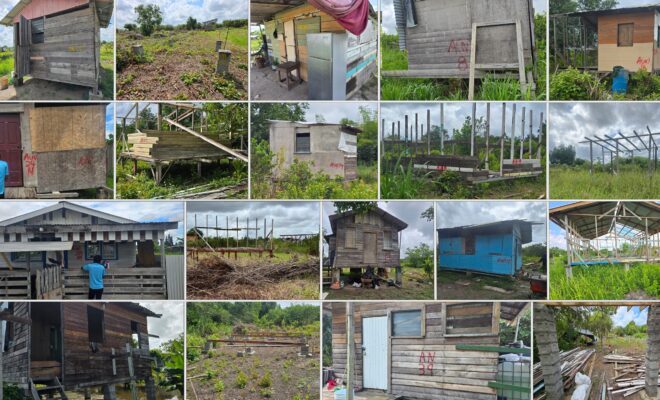
After years of uncertainty, hundreds of families living in the Plantation Arcadia Block IX (Mocha) squatting area along the East Bank of Demerara are beginning to see improved security and living conditions, as the Government advances a comprehensive regularisation and infrastructure development programme.
Residents began occupying the area nearly a decade ago, with significant settlement taking place between 2015 and 2020. Many families established homes and livelihoods despite the absence of legal land tenure, proper roads, drainage, utilities, or other basic services.
In response to the growing community and the need for orderly development, the Government initiated the regularisation of the Plantation Arcadia squatting area in 2024.
According to the Central Housing and Planning Authority, surveys were completed in early 2025, providing the framework for structured development.
The area has been subdivided into 209 residential lots and one public open space. Of these, 36 occupied lots have been identified as eligible for the processing of legal documentation, paving the way for residents to obtain secure land tenure.
The regularisation process moved into a new phase in November 2025, when document processing officially commenced at the Central Housing and Planning Authority’s Community Development Office.
This included payments, the issuance of allocation letters, and the signing of Agreements of Sale. To date, 15 Agreements of Sale and allocation letters have been completed, providing several families with formal recognition of ownership for the first time.
Alongside land regularisation, the Government has committed significant resources to improving infrastructure in the area. Contracts valued at approximately $765 million have been awarded under the Arcadia Squatting Development project.
The scope of works includes land preparation across 37.33 acres, the construction of about 3.5 kilometres of roads, and major drainage improvements.
Drainage and access works will involve the installation of 43 high-density polyethylene (HDPE) culverts, six reinforced concrete box culverts, and the construction of a 40-foot bridge. Utility services are also being expanded, with 3.56 kilometres of pipework to provide access to water, in addition to electrical infrastructure.
Officials say the combined approach of regularisation and infrastructure development is intended to improve living standards, reduce flooding, and enhance access and safety for residents. For families who have lived for years without basic services or legal certainty, the initiative represents a significant shift toward stability and long-term community development.