Barima sailed with eight unrecorded fuel drums, COI hears
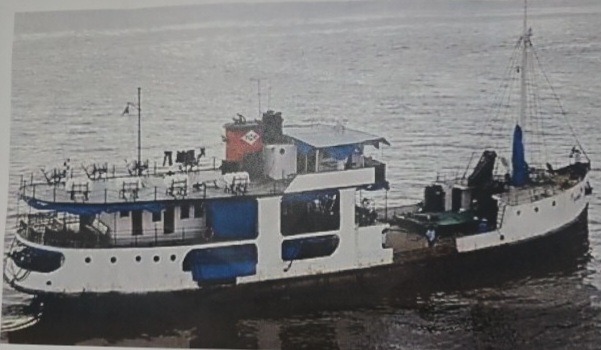
– Eight fuel drums missing from MV Barima manifest amid wharf staffing gaps
November 26 2026
8 of 10 fuel drums shipped by the Ministry of Public Works were left off the MV Barima’s main cargo manifest on the day the vessel sailed, even as key Transport and Harbours Department managers were absent and inspector staffing was cut in half, the Commission of Inquiry heard during Assistant Traffic Superintendent Michelle Reid’s testimony.
Commissioners noted that 10 fuel drums from the ministry were loaded onto the vessel for the Saturday, July 18 departure, yet only two appeared on the main cargo manifest. Six drums of gasoline were stored near the bow or foredeck away from engine-room heat and liquefied petroleum gas cylinders, while four drums of diesel were stored aft.
The inquiry heard that those drums were recorded elsewhere in a separate manual booking system. An extract from the Goods Wharf invoice book dated July 16, 2026, tendered as Exhibit MR3, accounted for the ministry’s six gasoline drums and four diesel drums alongside 100 sacks of fertilizer, listed as 50 plus 50, for the National Agricultural Research and Extension Institute, eight parcels for the Ministry of Education, and Region One items that included four solar panels, fittings, wire rope, and a freezer.
Reid’s testimony pointed to gaps across three overlapping booking channels used by the department. One is the standard manifest generated from items paid for upfront at the cashier or via Mobile Money Guyana.
A second is destination or excess cargo payment, where items are checked in at the wharf by checkers and tally clerks without upfront payment, paid for upon arrival in the North West District with a 25% surcharge if stowed in the hatch or a 100% surcharge if carried on deck, and reconciled later through purser remittance. The third is the government ministry invoice book, a separate manual book used when state agencies ship on credit or invoice rather than paying immediately.
Reid also told the inquiry that during a two-week redeployment to Goods Wharf after the tragedy to review records, she saw a list of more than 20 ice boxes and freezers whose owners had paid return freight fees of $12,000 for large wooden ice boxes, $5,000 or $775 for bins, and $4,500 for fridges and freezers.
On the staffing and command front, Reid testified that four traffic inspectors normally monitor wharf operations on sailing days, but acting Traffic Manager Stefan Skekel, who has since been placed on administrative leave, instructed that only two inspectors, Reid and Traffic Superintendent Ms. Willis, were needed for the July 18 sailing. Reid said Skakel likely believed two inspectors were enough because the hatch had finished loading on Thursday, July 16.
However, Ms. Willis informed the office she had to leave early and was not on the vessel when Reid boarded around 1:30-1:40 p.m., leaving Reid as the sole traffic inspector on duty.
Both Skekel and Assistant Traffic Manager Keane Holder, who oversees Essequibo operations, were absent from the wharf that day. Present at various times were Goods Superintendent Dallon Granderson, Goods Supervisor Suleika Andrews, Marine Superintendent Mr. Erskine, and at least two audit staff members, including Mr. Green and a junior auditor named Zachariah.
Commissioners expressed frustration over a muddled chain of command and uncertainty over who had authority to stop unsafe loading. Reid said she had never seen an organizational chart for the department, stating, “I have not seen it, but I’m told one exists.” She testified that she had received no marine-sector training and had no written guidelines for her inspector role, describing her work mainly as checking washrooms and gangway stages, observing irregularities, and reviewing office records.
“You have people who are not qualified passengers telling us for the last few days the danger they saw, the malpractice they saw, and none of these people could have done anything?” Commissioner Pritchard remarked during the hearing.
Near the close of her testimony, Reid broke down in tears while mourning colleagues, crew members, and passengers who died, including department staffer Kevin Hyman, whose body had still not been recovered, an engineer named Trevor Sam whom she remembered greeting while loading engine-room fuel drums that morning, boatswain Mr. Clark, and the canteen operator on board, Mr Cort.
“We feel the pain for all who lost their lives there, as much as they weren’t related by blood, some of them, but it was our family,” Reid said. “It’s not a day that goes by that our thoughts are not with the families, wondering what you could have done differently, or if you could have foreseen this disaster… Those are like my children, some of them who are younger than I am. Those my children, some of them like my brother, some my friends, all sad.”