“We don’t have a scale” – THD official on Barima loading
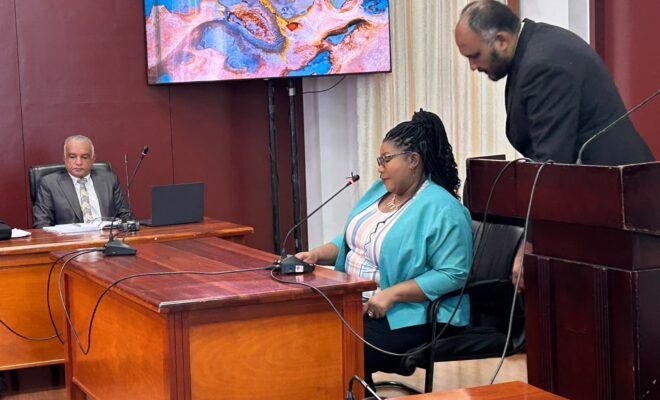
‘We don’t have a scale’ – Assistant Traffic Superintendent tells COI load line on MV Barima could not be seen as cargo loading continued past hatch closure
November 26 2026
Assistant Traffic Superintendent within the Transport and Harbours Department (THD), Michelle Reid, has told the Commission of Inquiry (COI) that she did not see the load line on the MV Barima on July 18, 2026, because of low tide, even as additional cargo continued to be loaded onto the vessel after its main hatch had already been closed since Thursday, July 16.
Testifying before the Commission, Reid, who has worked with THD for 15 to 16 years as Goods Superintendent until 2024 and just under two years in her current post, said the department has no scale to weigh goods and no load-line or stability documentation on board for the MV Barima.
“Remember, we don’t have a scale, to weigh in when you put stuff there. You’ve got to see how it affects the loading and how much of a particular cargo we’ll be able to take,” Reid told the Commissioners.
Explaining how the load line is normally checked during loading, Reid said she took guidance from a white circle with a line in the middle painted on the hull, alongside verbal updates from the captain or mate regarding draft measurements in feet. However, she testified that on July 18, she could not see it.
“I didn’t particularly look for it, but the tide was really low, so I could not get to see, even if I tried. I couldn’t get to see it,” Reid stated.
She further agreed under questioning that once the MV Barima was moved from the inside of the wharf to the outside, starboard side of the MV Malisha, it became virtually impossible to view the load line from the wharf.
“There was no way that I could have seen what was going on there,” Reid said, confirming it would have been “extremely difficult, assuming it was visible in the first place, to see the load line” once the MV Barima assumed that position.
Reid explained that the MV Barima, which had a scheduled 1:00 p.m. sailing time, was shifted outside the MV Malisha into deeper channel water because of low tide and ongoing loading.
“Seeing that the boat was on the inside and the tide was low, I figured that they needed to put the boat on the outside because if they put more weight on the boat and the tide is low, it would grub up on the bottom there. So that’s one of the reasons for putting the boat on the outside, which is more in the channel,” she testified, adding that she did not know the exact water depth.
Commissioners also pressed Reid on how a relatively junior captain, identified in testimony as Captain Price whom Reid estimated had held his captain’s license for only one or two years, could determine safe weight limits when there were no loading manuals, stability booklets, or weight figures for vehicles such as a white sedan, a black Toyota Tundra pickup, or an all-terrain vehicle (ATV).
Reid maintained that monitoring the load line and refusing excess cargo rested with the captain.
“At the end of the day, the captain has the right to refuse cargo. He has to know the safety. He has to know his limits,” Reid said. “It matters not what the marine superintendent would say, what the superintendent would say, what the customer would say, or anybody. At the end of the day, he’s responsible for taking the ship out there. And he has the right to refuse, or he can pick up his bag and walk out of the boat and say he’s not taking it.”
She noted that in past years, captains had refused to sail or threatened to walk off when customers rushed goods aboard, and that crews sometimes had to remove gangway stages to stop people from forcing cargo onto vessels.