LCDS 2030 approved in National Assembly

The updated Low Carbon Development Strategy (LCDS) was on Monday approved in the National Assembly, paving the way for the mobilisation of financing that will be accrued from the country’s forest resources.
Senior Minister in the Office of the President with responsibility for Finance, Dr. Ashni Singh highlighted the strengths of the strategy as he moved the LCDS 2030 motion during the National Assembly.
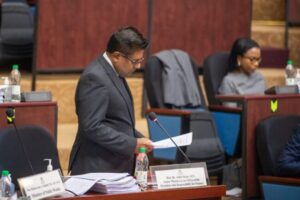
Assuring that these resources will be invested prudently, he said “We will ensure therefore that the revenues we earn from the LCDS are processed through the most rigorous budgetary process.”
The LCDS 2030, Minister Singh said has benefitted from intense technical assessment, and extensive consultations from citizens in communities across the ten administrative regions. Notably, the document has also benefitted from international consultations.
The minister expressed disappointment that the Opposition did not partake in this consultative process.
Amerindian Affairs Minister, Pauline Sukhai noted that, as part of the national consultation, the LCDS Multi-Stakeholder Steering Committee (MSSC) was re-established to guide the LCDS as it did in the period from 2009 to 2015.
She pointed out that representatives from all major civil society organisations, the private sector, conservation organisations, Amerindian people’s organisations, and other stakeholders were afforded the opportunity to share their ideas and suggestions, to help shape the approach for how Guyana can achieve developmental goals that will benefit people across the country.

Minister Sukhai said the strategy also received the endorsement of the newly-elected Chairman of the National Toshaos Council, Derrick John.
Meanwhile, Natural Resources Minister, Vickram Bharrat during his contribution, restated the PPP/C Government’s commitment to achieving most of Guyana’s electricity requirements through renewable energy and utilising natural gas, while at the same time pursuing renewable energy opportunities.
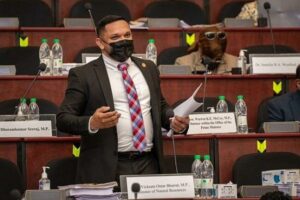
Reference was also made to the country’s world-leading forest Monitoring, Reporting, and Verification System (MRVS).
Minister Bharrat said Guyana deserves to be paid for the preservation of its forests and its resources.
Throwing his support behind the motion, Deputy Speaker of the National Assembly, Lennox Shuman endorsed the LCDS 2030, describing it as a comprehensive document that benefitted from the inclusion of the Amerindian people, something that was absent under the APNU+AFC.
He said it is clear that the strategy makes provision that will see present, and future generations benefitting holistically.
Guyana in 2009, launched the first Low-carbon Development Strategy (LCDS) from a developing country, setting out a vision for inclusive, sustainable development, while simultaneously maintaining the country’s forests.
Our forests account for approximately 85 per cent of the country’s territory, to help meet some of the most urgent challenges the world faces.
Guyana also has the second highest percentage of forest cover on earth and is working with partners to sustain 99.5 per cent of that forest while building the foundation for a new low-carbon, ecosystem economy.
According to the Executive Summary of the LCDS 2030, “The expected opportunity to access a market mechanism for forest climate services, and other ecosystem services, will enable Guyana to store 19.5 billion tons of carbon dioxide equivalent (the measure used for greenhouse gas emissions – the world emits about 50 billion tons a year).” Simultaneously, Guyana can grow its economy five-fold over 20 years and keep energy emissions flat; invest in Amerindian, Hinterland and sustainability planning; protect the coast and Hinterland from climate change; create jobs; and integrate Guyana’s economy with its neighbours.