Redistricting gamble backfires as democrats seize congress
November 4 2026
A controversial Republican effort to redraw congressional district boundaries in an attempt to preserve control of the US House of Representatives has backfired, with Democrats successfully defending several targeted seats, flipping traditionally Republican districts and reclaiming control of Congress.
The redistricting campaign, championed by President Donald Trump and Republican lawmakers, began last year as an aggressive attempt to strengthen the Republican Party’s narrow congressional majority ahead of the 2026 midterm elections. However, the results have delivered a significant political setback for the administration, as Democrats turned the strategy into an opportunity to make gains of their own.
Democrats successfully defended targeted congressional seats in Florida, Texas, Ohio, Alabama and North Carolina, while making additional gains through counter-redistricting efforts in California and Utah.
In Texas, Democrats secured important victories in districts Republicans had redrawn to improve their electoral chances. Democratic Representatives Henry Cuellar and Vicente Gonzalez retained their seats, while Democrat Bobby Pulido defeated Republican Representative Monica De La Cruz in another closely watched contest.
Florida also proved challenging for Republicans, with Democrats successfully defending several districts targeted by the GOP’s redistricting efforts. Among those retaining their seats were Representatives Jared Moskowitz, Kathy Castor and Darren Soto.
Democrats also held their ground in Alabama, where Representative Shomari Figures successfully defended his seat, as well as in Ohio, where Representatives Greg Landsman and Marcy Kaptur secured victories. In North Carolina, Democrat Don Davis also mounted a strong defence of his district.
Meanwhile, Democrats capitalised on redistricting efforts of their own. California’s newly approved congressional map helped the party secure additional seats, while a Democratic victory in Utah further demonstrated the party’s ability to compete in districts previously considered favourable to Republicans.
The results highlight how a strategy intended to give Republicans an electoral advantage ultimately failed to produce the expected outcome. Rather than securing a stronger congressional majority, the redistricting battle contributed to a series of expensive and highly competitive races that exposed the limitations of manipulating electoral boundaries to guarantee political victories.
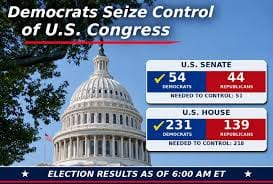
Beyond the individual district contests, the most consequential development was the Democrats’ return to power in Washington. According to Reuters, the party secured control of both the House of Representatives and the Senate, placing the Trump administration in a significantly more difficult political position.
With Democrats preparing to assume control of both chambers in January, the administration is likely to face increased congressional scrutiny, resistance to its legislative priorities and the possibility of investigations into its policies and decisions.
What Republicans envisioned as a historic effort to protect their political dominance has instead become a major electoral setback, demonstrating that while political boundaries can be redrawn, the outcome of an election ultimately remains in the hands of voters.


