Unpaid freight, questionable ledgers exposed in Barima inquiry
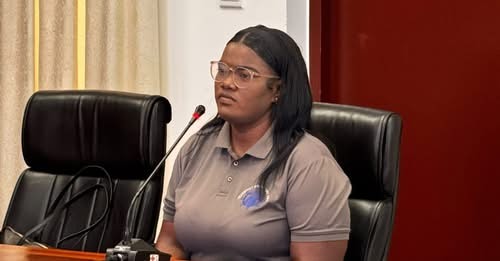
Ferry inquiry orders full 2026 cargo logs and WhatsApp records as checker admits no way to verify unpaid freight…
November 27 2026
A Transport and Harbours Department (T&HD) port checker, Kessa Case has admitted before the Commission of Inquiry into the fatal July 18 sinking of the Barima that she has no way of knowing whether cargo loaded without upfront payment is ever actually paid for at its destination, prompting commissioners to demand all 2026 checking logbooks, slipbooks, to-pay lists, and exported WhatsApp messages from the wharf.
During continued questioning ahead of the lunch recess, checker Case, who testified she has worked at the department for roughly 11 months, was walked through the step-by-step handling of bulk cargo arriving days before departure. Using a hypothetical shipment modeled on regular shipper A.K. Kenneth’s June 6, 2026 consignment of 50 cases of Rude Boy, 30 cases of Corona, 15 bales of toilet tissue, 104 cases of ramen, milk, baby formula, tuna, sausages, Pampers, Heineken, and butter, commissioners traced how goods pass through the security gate, are written into a checker’s book, and are placed into the bond before being loaded by forklift onto the vessel.
Case confirmed that a customer can drop off massive quantities of goods days in advance, leave without paying, and still have the cargo loaded onto the ship on departure day to be billed “on the other side.” Under the wharf’s informal process, checkers compile a loose-leaf “to-pay list” after checking the cashier’s manifest, photograph it, and send it via WhatsApp to the vessel’s purser, even though cellular signal drops out miles offshore until the vessel nears its first port of call, such as Morawhanna or Port Kaituma.
Yet when pressed on how collection works once the vessel docks, Case admitted she did not know whether the purser carries a receipt book, who collects the money at the destination, or whether the freight is ever settled. “I don’t know if the purser would collect payments for cargo,” Case told the panel, adding, “Who collects payment, I’m not sure how it’s done over that side. I’m not sure how things is being done on that end.” Asked directly whether she has any way of knowing if unpaid shipments are eventually paid for, she replied, “No, I can’t say.”
Commissioners also dissected deep flaws in the physical ledgers and customer identification practices at the Georgetown wharf. Unlike a sequentially numbered accounting book, Case’s ledger restarts its page numbering from one at the start of each new trip, leaving unnumbered gaps between sailing dates and entries dated out of sequence, such as entries for May 2, 2026 appearing immediately after April 18, 2026 without page numbers. “What I’m saying is this ledger, to put it plainly, is a mess,” one commissioner told Case, questioning why pages were not simply numbered consecutively to prevent sheets from being removed unnoticed.
Further questioning by Commissioner Alfonso and fellow panel members exposed the absence of any central customer directory at the wharf. Checkers routinely log shippers using bare initials, nicknames, or first names, such as “R.C.,” “Milo,” and “Sue”, often without recording a telephone number. Case testified that when contact details are omitted from her book, she relies on fellow checkers to supply the phone numbers from their own records or memory, while conceding that no master directory of customer names, addresses, or numbers exists at the department.
Before breaking for lunch, the commission issued a sweeping directive for the afternoon session, instructing that all 2026 checking logbooks for every checker on duty, the current and previous 2026 official slipbooks, all 2026 to-pay lists for the Barima held by cashier Kenese McLean, and electronic exports of the checkers’ internal WhatsApp group be produced to the inquiry.