Police Service Commission Chairman lawfully appointed but Commission not properly constituted—Chief Justice rules

President Dr Irfaan Ali’s appointment of the Police Service Commission (PSC) Chairman, Patrick Findlay and members of the Integrity Commission was done constitutionally.
That was the ruling of Chief Justice Roxane George, SC on Tuesday on Opposition Leader Aubrey Norton’s case to have the appointments quashed on the basis that the Head of State failed to engage him in the constitutionally required meaningful consultation.
Norton had also argued that the President did not give him sufficient reasons upon which the nominees for PSC and Integrity Commissions were made and subsequently appointed.
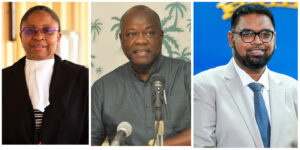
Chief Justice Roxane George, SC; Chief Justice Roxane George, SC; President Dr Irfaan Ali
Apart from Findlay, the members of the PSC are businessmen Ernesto Choo-a-Fat, Hakeem Mohammed and Attorney-at-Law Mark Conway.
Demerara Bank’s Corporate Secretary, Chandra Gajraj is the Chairperson of the Integrity Commission while the other members are Mohammed Haniff, Attorney-at-Law and former Solicitor General Kim Kyte-Thomas, Hardesh Tiwari, and Reverend Wayne Chris Bowman.
Both the PSC and Integrity Commissions were appointed on May 31.
Norton, who is also the leader of the PNCR—the largest party in the Opposition APNU+AFC Coalition—was ultimately seeking an order quashing the appointments, and a declaration that all actions taken by the Commissions are null, void, and of no force and legal effect.
Contending that the Integrity Commission was not appointed in accordance with the Integrity Commission Act, the politician also asked the High Court to quash the appointment of the Commission’s Chairman and members and to declare all actions taken by it null and void.
The Chief Justice, however, refused to grant any of these reliefs to Norton, noting that the constitutional and statutory regime was followed by the President in appointing the Chairmen and members of the two constitutional commissions.
Alluding to letters sent to Norton by Governance and Parliamentary Affairs, Minister Gail Teixeira concerning the appointment of the Commissions, the Chief Justice found that sufficient information on the nominees and reasons for their nominations were provided.
According to her, in Minister Teixeira’s letter, Findlay and the members of the Integrity Commission were described as “persons of good standing” and “outstanding Guyanese”. These descriptions, Justice George said, amount to reasons for their appointment.
Given that Norton was provided with the nominees’ CVs on May 16, the Chief Justice held that he had “all the necessary information to form a considered opinion”, adding that he had “ample time to let his views be known” on the President’s nominees for the Commissions.
In the circumstances, she ruled that there was procedural fairness and that the consultation process between the President and Opposition Leader can be deemed sufficient, therefore ruling that the appointments were constitutional and lawful.
Not properly constituted
In relation to Norton’s argument that the PSC was not properly constituted because there is no Chairman of the Public Service Commission, this was upheld by the Chief Justice.
As such, she said that the Chairman of the PSC, Patrick Findlay could not have “properly engaged” with President Ali and other members of the Commission on the appointment of Clifton Hicken to act as Commissioner of Police.
Considering this, the Chief Justice applied the de facto officer doctrine to save all actions taken by the PSC, including the recent promotion of several senior Police officers.
Hicken’s appointment as the nation’s acting Top Cop remains lawful, she emphasised for the avoidance of any doubt, referring to her August 11 ruling in which she upheld the appointment made by President Ali.
Hicken’s appointment took effect on March 30. The Constitution mandates there be meaningful consultation between the President and Opposition Leader on the appointment of a substantive Commissioner of Police or someone to act in that post.
Following the resignation of Joseph Harmon on January 16, the office of the Leader of the Opposition remained vacant until April 13– when Norton was appointed.
Justice George, therefore, found that there was no Opposition Leader with whom the President could meaningfully consult on the appointment of a Commissioner of Police and that the Head of State acted “reasonable”, “in his own deliberate judgement” and “in the interest of national security” when he made the appointment.
Meanwhile, in ending her ruling on Norton’s application, the Chief Justice expressed that it is “highly unfortunate” that service commissions provided for by the Constitution—the supreme law of the land—have not been constituted or reconstituted”, noting that this is a disservice to the entities they serve and the country.
Defending President Ali’s appointment of the PSC, Attorney General Anil Nandlall, SC had submitted that Norton “had a hand” in the appointment of this constitutional Commission.
Besides there being consultation via letters and an in-person meeting between President Ali and Norton, Nandlall had told the Chief Justice that the nominees for the PSC, including Findlay, were unanimously approved by the Appointments Committee of the National Assembly.
“The names were examined and approved by the Appointments Committee of which the Opposition Members are part. That Committee prepared a report and presented it to the National Assembly. The National Assembly approved that report unanimously containing the four names. The Leader of the Opposition was in the National Assembly…,” Nandlall had said.
Norton was represented by Roysdale Forde, SC and Attorney-at-Law Selwyn Pieters.
Appearing on behalf of Nandlall, a respondent in Norton’s action, were Solicitor General Nigel Hawke, State Counsel Chevy Devonish and other lawyers from the Attorney General’s Chambers.