Edghill’s 268-ton Barima figure challenged by witness testimony
-Official 268-ton cargo figure did not reflect actual weight, witness admits at inquiry
November 26 2026
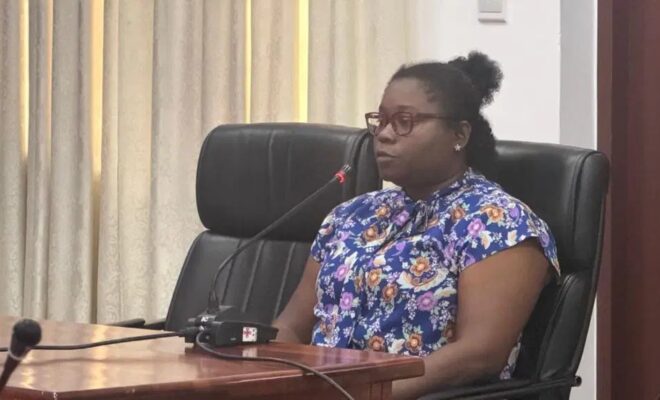
Testimony before the Commission of Inquiry into the capsizing and subsequent sinking of the MV Barima moments ago has revealed that an officially reported cargo figure of 268 tons for a July 18 sailing was derived from a revenue-based formula rather than the physical weight of goods loaded onto the vessel, according to witness Kenese McClean.
However, on July 19, Minister of Public Works Juan Edghill dismissed claims that the vessel was overloaded or had suffered engine failure, stating that the MV Barima was licensed to carry 284 tonnes of cargo and that its manifest showed 268 tonnes on board.
Pressed directly on whether dividing revenue by $6,200 yields the actual physical weight of cargo on the vessel on the 18th of July, witness Kenese McClean acknowledged before the Commission of Inquiry that the formula does not produce actual weight, stating, “That’s true,” before adding, “But it is how it is. This is how they arrive at their actual total amount.”
The admission came at the close of questioning over how cargo tonnage is calculated from revenue figures, whether official weight totals reflect actual vessel loads, and why printed manifests differed from handwritten records.
Questioning opened with follow-up tasks assigned after the previous day’s adjournment, including reconciling the printed manifest against the handwritten manifest and checking departmental records for requested documents. McClean confirmed she completed “a few of them” and prepared a cover document outlining what she was asked to do and how successful or unsuccessful she had been, though she did not have that cover paper with her.
Commissioners also noted her assistance in providing 5 days of records from 2024, revenue and tonnage records covering 2024–2026, timely access to the invoice book, and reports on a flash drive, including a report in soft copy concerning June 24, 2026.
Attention turned to exhibits entered into the record, including a letter dated the 22nd of July, 2026, addressed to traffic manager Mr. Skelker, marked as exhibit KM 5, covering goods shipped on credit from Georgetown to Port Kaituma for the Ministry of Public Works, Ministry of Agriculture, Ministry of Education, and Ministry of Health. Counsel also addressed the tonnage and trip reports for 2026.
Comparing the invoice book page for the 16th of July against an electronic record exposed missing entries on the handwritten side, specifically an all-terrain vehicle for the Ministry of Public Works and a corpse casket for the Ministry of Health. Explaining the gap, McClean testified, “So my supervisor came to me and said, they have a corpse. Where the casket normally goes with the corpse, it normally cash separates. So this is why the casket is there.” She added that 2 adult tickets were also tied to the matter because 2 passengers had not booked their tickets in advance, explaining, “And I explained to him, sir, if you go away, you do not book all of the tickets, you will not be able to go on the vessel.”
When the customer returned on the day of the sailing with the corpse and no tickets remained, she consulted her supervisor and recorded the items under the Ministry of Health because the ministry was paying for the process. She said the all-terrain vehicle was handled similarly after her supervisor instructed her to note it for the Ministry of Public Works and she entered it directly into the system rather than writing it in the book.
When pressed on whether she had completed the 24-hour reconciliation between the electronic printed manifest and the handwritten manifest, McClean stated she did not have the actual book, noting it had been taken in connection with an incident where customer names and families were checked and remained with a colleague, while a printout she received from a colleague was hard to read.
Asked how discrepancies such as extra names or names appearing on one record and not another would be handled, she said such issues should be rectified with a supervisor, identifying Grandison as the immediate supervisor at that time.
Commissioners then examined the computations on the last page of the exhibit she presented for the 18th of July, 2026, beginning with the abbreviation “TON” and confirming it refers to weight in metric tons. McClean explained that posted cargo of 206 tons was derived by taking a revenue figure of 1,281,698 and dividing by $6,200.
Asked about the origin of the $6,200 figure, she recalled her supervisor referring to B-class and C-class tonnage, describing B-class items as eatables and C-class as non-eatables such as wheat, supposedly combined and divided to reach $6,200, though she did not know the formal background behind it and noted it was a rate she had inherited.
McClean testified that the $6,200 calculation applies to Kaituma, while other destinations such as Maburuma would have a different tonnage rate, even though cargo stopping at places like Morowhanna or bound for Maburuma could still be processed or cashed through the same system drawer and appear in overall totals, including freight cargo of 385,160.
Adding 206.7265 and 62.123 from the freight and posted cargo lines produced roughly 268.849 tons, rounded down to 268 tons, the figure previously reported officially as cargo on board, before accounting for additional items below such as vehicles, an all-terrain vehicle, fertilizer, bags of parcels, and caskets. She explained that the initial 268-ton figure came from adding freight and cargo with the information immediately at hand to give to supervisor Grandison, with remaining items such as freight notes and ministry entries added later on the following Monday.
Comparing an earlier voyage on the 26th of June, commissioners noted 67.074 tons of freight cargo plus 227 tons for about 295 tons of cargo and higher total revenue of $2,160,955. Commissioners pointed out a conflict with deck logbooks, noting that the 26th of June was the only loading in roughly 2 years of deck logbooks marked at the load line, 7 feet, 6 inches, corresponding to about 100 tons rather than 295 tons, a roughly 300-percent gap.
McClean maintained she works with the revenue and tonnage figures given to her in the system and cannot determine vessel overload from that revenue-based calculation alone.
Reviewing passenger counts on the 18th of July list, commissioners tallied 20 passengers, 4 children, 49, 16, 10, 3, 7 pensioners, 5 under 2 years, 5 children, and the 2 Ministry of Health passengers traveling with the family of the deceased, reaching 116 persons generating roughly $250,000 in passenger revenue, while noting cargo, alongside comparisons to passenger counts of 211, 177, and 285 on the 27th of February, drives the bulk of revenue.