CCJ orders government to pay $179.9M arbitration award
March 13 2026
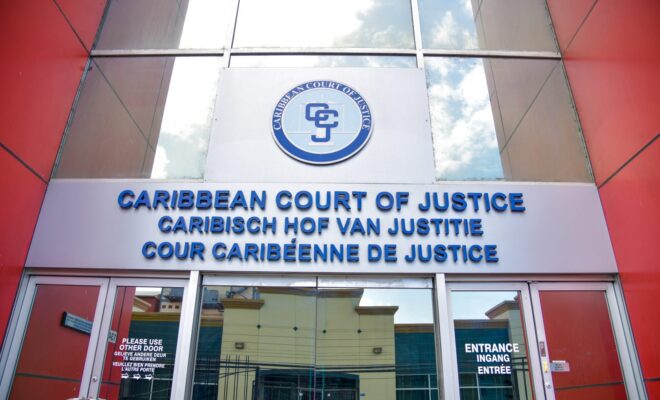
The Caribbean Court of Justice (CCJ) has ordered the Government of Guyana to pay $179,946,850 to contractor Azad Meerza after dismissing the state’s appeal in a long running dispute over road works.
In a judgment released this week, the regional court upheld an earlier ruling by the Court of Appeal of Guyana that an arbitral award granted to Meerza must be enforced.
The matter arose out of a 2009 contract between the Government of Guyana, acting through the Attorney General, and Meerza of Falcon Transportation and Construction Services for the execution of road works.
During the execution of the project, disagreements developed between the parties which were eventually referred to arbitration.
In March 2015, an arbitral tribunal ruled in favour of Meerza. However, the High Court of Guyana later refused to enforce that first award after determining that the arbitration panel had been improperly constituted.
Following that ruling, Meerza returned to the High Court seeking the appointment of a new arbitration tribunal under the Arbitration Act of Guyana.
Acting on directions from the High Court, Meerza nominated arbitrator Edward Gonsalves to serve on the reconstituted panel.
The government did not object to that nomination at the time, and the remaining members of the tribunal were appointed in the months that followed.
The newly constituted panel proceeded to hear the dispute again. Despite being notified on several occasions, the government did not participate in the arbitration proceedings.
After reviewing the matter, the tribunal once again ruled in favour of Meerza and awarded him $179,946,850.
Meerza subsequently returned to the High Court seeking enforcement of the second arbitral award.
At first instance, the court refused the application, concluding that the tribunal had been improperly formed and reasoning that a previous court order had effectively brought the tenure of the earlier tribunal to an end.
The decision was later overturned by the Court of Appeal, which held that the government was barred from challenging the composition of the tribunal because it failed to object within the timeframe required by the UNCITRAL Arbitration Rules.
The appellate court then ordered that the award be enforced.
The government appealed that ruling to the CCJ, arguing that the reconstituted tribunal was affected by apparent bias because Gonsalves had served on the earlier arbitration panel which had previously adjudicated the same dispute.
It also argued that the arbitrator should have disclosed his earlier involvement.
In its judgment, the CCJ acknowledged the importance of disclosure in arbitration proceedings but concluded that no breach had occurred in this case.
The court stated that “the fact of Mr Gonsalves’ prior involvement as an arbitrator was no secret, and in those circumstances, he did not violate any duty to disclose what was already known.”
Addressing the allegation of bias, the CCJ applied the common law test used to determine whether a tribunal is impartial.
It stated that the relevant question is “whether a fair minded and informed observer, having considered the facts, would conclude that there was a real possibility that the judge was biased.”
The CCJ rejected the suggestion that prior involvement alone was enough to establish apparent bias.
According to the judgment, “the mere fact of having sat on a panel that previously adjudicated on the same dispute between the parties does not automatically give rise to a presumption of apparent bias,” adding that “something additional of substance is required for such a finding.”
The court also examined the government’s delay in raising its objection to the composition of the tribunal. Under the UNCITRAL Arbitration Rules, a challenge to an arbitrator must be made within 15 days.
However, the CCJ found that the government waited more than seven months before raising its objection.
The court noted that international arbitration case law discourages parties from remaining silent during proceedings and only raising objections after receiving an unfavourable result.
Such conduct, the regional court said, “results not only in a waste of time and resources but is also fundamentally unfair to the other party who may have diligently participated in the process.”
The CCJ further noted that the government had been aware of the arbitration process and had been represented at various stages of related court proceedings, which was supported by correspondence exchanged between the parties.
In the circumstances, the court concluded that the government had effectively waived its right to challenge the tribunal’s composition.
The CCJ therefore dismissed the appeal and affirmed the ruling of the Court of Appeal, meaning the arbitration award of $179,946,850 in favour of Meerza must now be enforced.
The CCJ further ordered that the appellant must pay standard costs to the respondent based on the proposals on costs submitted in the parties’ respective case management checklists and the agreed value of the appeal.
This order was made pursuant to Rule 17.15 and Schedule 2 of the Caribbean Court of Justice (Appellate Jurisdiction) Rules 2024.
Solicitor General Nigel Hawke, together with attorneys Raeanna Clarke, Mohanie Sudama and Shania Persaud, appeared for the Attorney General on behalf of the appellant.
Azad Meerza, the respondent, was represented by Senior Counsel K. A. Juman-Yassin and attorney Teni Housty.
The CCJ panel presiding over the case comprised President Justice Winston Anderson, Justice Maureen Rajnauth‑Lee, Justice Peter Jamadar, Justice Chantal Ononaiwu, and Justice Chile Eboe‑Osuji.