Trump claims major economic revival under his administration
February 26 2025
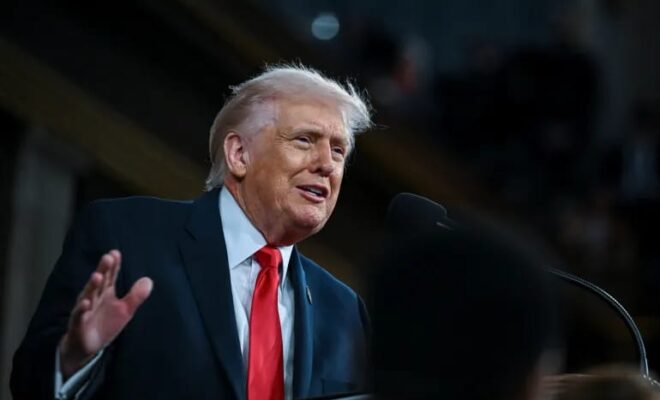
In a historic and highly partisan moment at the U.S. Capitol on February 24, 2026, President Donald J. Trump delivered the longest State of the Union address in American history, framing the nation’s current condition as evidence of a dramatic economic and security “turnaround” under his administration while stoking sharp political divisions inside and outside the chamber.
Speaking to members of both chambers of Congress, Supreme Court justices, diplomatic guests and a nationwide television audience, Trump touted what he described as robust gains in jobs, inflation, energy, and border security. He also took aim at Democrats and the judiciary for resisting key elements of his agenda.
At 9:12 p.m. EST, Trump launched into a nearly 1 hour, 48-minute address surpassing previous records for length declaring that “America is back bigger, better, richer, and stronger than ever before.”
Trump opened with a detailed appraisal of the economy, focusing on household incomes and falling prices. He asserted that inflation has dropped sharply over the past year, citing a core inflation rate of about 1.7 % in late 2025 and significantly lower gasoline prices compared with the previous administration, before wrapping his policies in a narrative of national renewal.
The president also highlighted job creation, claiming that more Americans are working now than at any point in history a statement grounded in official employment figures but nuanced by analysts who note slower job-growth trends compared with recent years.
Trump called for expanded tax cuts, strengthened voter identification laws, and continued emphasis on border security. His proposals including a “Save America Act” that would mandate proof of citizenship for voter registration are expected to intensify congressional debate ahead of the 2026 midterm elections.
The partisan tenor of the evening was unmistakable. Dozens of Democratic lawmakers either boycotted the address or staged protests on the National Mall, while others loudly disrupted portions of Trump’s remarks inside the chamber, defying party leadership’s admonitions.
Republicans responded with prolonged standing ovations to many of Trump’s applause lines, particularly on immigration and economic growth. One rare moment of bipartisan recognition came when Trump introduced the U.S. Olympic men’s hockey team and announced the awarding of the Presidential Medal of Freedom to goalie Connor Hellebuyck.
Independent fact-checking organizations and major news outlets noted that many of Trump’s statements contained exaggerations, misleading claims, or lacked full context, particularly on crime, inflation, and trade policy achievements. Critics pointed out that while employment figures are high in absolute terms, growth rates have slowed and that some policy outcomes do not fully align with the president’s framing.
Meanwhile, the broader political landscape continues to shape the address’s impact: Democratic leaders used their response platform to criticize the administration’s approach to affordability and immigration, and public opinion appears sharply divided along partisan lines.