Karimbaksh under fire for obstructing lawful police operation

May 6 2026
An intervention by Deputy Commissioner – Head of the Special Organised Crime Unit (SOCU) Fizal Karimbaksh, in a routine traffic stop has triggered grave concern about the integrity of law enforcement operations and the consistent application of the law within the Guyana Police Force (GPF).
The incident was first made public by BIG Smith News Watch, who shared a video showing the encounter in which Karimbaksh identified himself over the phone during the exchange with ranks.
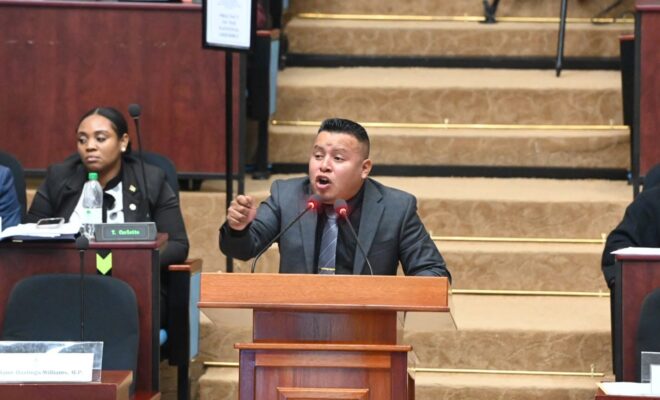
In a statement issued today, A Partnership for National Unity (APNU) Member of Parliament Sherod Duncan said the matter raises serious questions about accountability and whether established procedures were bypassed during the execution of lawful police duties.
The incident which occurred on Sunday, during an anti-crime exercise when ranks stopped a white Vezel motorcar after observing multiple traffic violations, including tinted windows and an obscured registration plate.
After the driver was stopped, she contacted Deputy Commissioner Karimbaksh via phone call, who identified himself to the police rank and subsequently instructed the officer to terminate the stop and allow the woman to leave.
The driver, who reportedly identified herself as a police officer attached to SOCU, had Karimbaksh’s name saved in her phone under his first name ‘Fizal’, suggesting a close working relationship between the two.
It was also reported that the driver informed ranks she was not in possession of her driver’s licence at the time of the stop.
Duncan, in his statement, described the development as troubling, arguing that it raises concerns about whether internal influence was used to override standard enforcement procedures.
He warned that such actions, if confirmed, could undermine operational integrity and weaken public confidence in the justice system.
It was noted that police ranks were acting within their legal authority, pointing out that any gazetted officer is empowered under law to stop and search vehicles where reasonable suspicion exists, and that there is no requirement limiting such powers exclusively to traffic personnel.
The MP also cautioned that interference in active police operations without full knowledge of the circumstances risks disrupting enforcement efforts and could create perceptions of unequal application of the law.
Duncan is calling for urgent clarification from both senior leadership of the GPF and the Ministry of Home Affairs, including an explanation of the legal basis for the intervention and whether any internal review has been initiated.
He stressed that the issue goes beyond a single incident, framing it as a matter that speaks to broader concerns about discipline, accountability, and public trust in law enforcement institutions.
See full statement from MP Duncan here:
“The reported alleged intervention by Deputy Commissioner of Police and SOCU Head. Fizal Karimbaksh. in a routine anti-crime stop raises serious questions about consistency, command discipline, and the application of the law. At a time when the Guyana Police Force (GPF) is under heightened scrutiny, any action that appears to override standard operating procedures risks undermining both public confidence and frontline enforcement efforts.
The circumstances outlined are particularly troubling. Ranks conducting a lawful stop, based on visible infractions including tinted windows and an obscured registration plate, were reportedly instructed to release the individual after a phone call from the senior officer. Compounding the concern is the reported inability of the driver to produce a valid driver’s licence, alongside her identification as a SOCU-affiliated officer. These are not minor procedural issues; they go directly to the principle of equal application of the law.
From an institutional standpoint, this incident highlights a potentia breakdown in operational integrity. The law empowers ranks to act on reasonable suspicion and visible violations.
When those actions are interrupted withou transparent justification, it sends a conflicting signal within the Force, one that may discourage diligence and weaken the chain of accountability. It also raises legitimate questions about whether internal hierarchies are being used to circumvent enforcement, rather than uphold it.
This matter requires urgent clarification from the leadership of the GPF and the Ministry of Home Affairs. A clear account of the facts, the legal basis for the intervention, and any subsequent internal review must be provided. At its core, this is not simply about one incident; it is about preserving the credibility of law enforcement. ensuring value for public expenditure on security, and reinforcing the principle that no individual or unit operates above the law.”