Barima cargo discrepancies raise questions over missing revenue
Inquiry probes missing cargo and uncollected revenue after 112 extra gas cylinders loaded onto MV Barima
November 25 2026
More than double the number of gas cylinders recorded on the official manifest, along with unmanifested oil bottles and vehicles, were loaded onto the MV Barima before its fatal July 18, 2026 departure, raising questions about missing revenue, separate manual log books, and skipped reconciliations.
Testifying before the Commission of Inquiry, Transport and Harbour Department clerk three, Kenese McClean, an employee of more than 15 years, faced sustained questioning over how large volumes of cargo bypassed the computerized billing system without being cashed in Georgetown.
Commissioners confronted McClean with discrepancies between printed receipts and CCTV footage of the vessel’s loading, revealing that while 101 gas cylinders, 91 twenty-pound, four 40-pound, and six 100-pound cylinders, were logged on the manifest, 213 cylinders were counted going aboard, alongside 10 bottles of oil loaded compared to two listed, and vehicles absent from the printout.
Working inside an enclosed room as a cashier, McClean maintained she can only enter and collect money for items written on slips brought to her by customers after passing through outside checkers. “Without the slip coming to me to cash, you understand, I can’t cash the item because I didn’t see a slip coming for those items,” she testified, attributing the breakdown to “negligence of my colleague” and pointing to floor and loading supervisor Jamaica Andrews as the person overseeing what goes onto the vessel.
Tracing how unmanifested cargo is supposed to be tracked and paid for, McClean disclosed that outside checkers and pursers, naming Miss Jamaica, Miss Andrews, Miss Case, Miss Ramarin, and Mr. Chapman, maintain separate manual log books, including a “gas book” and a “bag book,” to record checked-in items by customer name and quantity.
She explained that in a proper check-and-balance process, cashiers and checkers sit together to compare the manual logs against the digital manifest, compile a “to-pay list” for any missed items, and hand that list along with the manifest to the vessel’s purser, who travels on board and is required to collect a 25 percent penalty fee upon arrival in Region 1 ports such as Port Kaituma and Kumaka before releasing goods.
However, McClean admitted that no such reconciliation took place for the July 18 sailing because the boat departed on a Saturday and staff went home. “Honestly speaking, that trip we did not sit down together, because it was a Saturday,” she told commissioners, adding, “It was a Saturday, you understand, and afterward, everyone was tired, so we did not sit back afterward to sit down and go through it.”
She added that while receipts are normally required to clear cargo at destination ports, pursers also distribute goods based on customer names marked on items, and noted that typical overall cash takings for a voyage range between $800,000 and $1 million, with one freight listing alone showing $388,160.
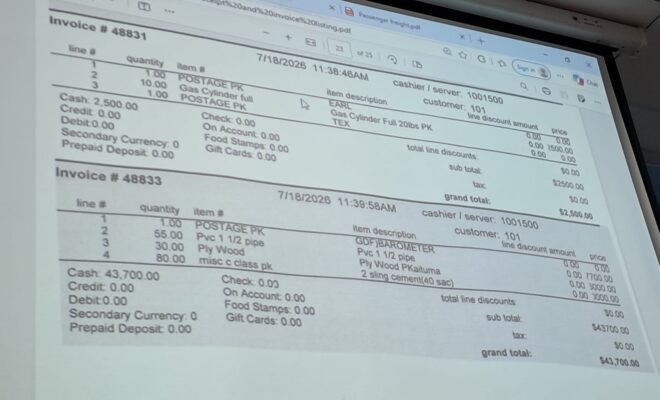
The inquiry also examined specific manifest anomalies, including 844 cases of Banks beer, government agency shipments billed via head-office accounting vouchers rather than cash, and a July 18 entry under “GDF Baramito” for 55 PVC pipes, 30 sheets of plywood, and 80 sacks of cement totaling $43,700 that appeared to have been paid for on the spot by an unidentified soldier.
McClean confirmed that cargo intake began on July 13 ahead of July 14 invoices, that post-voyage checks against handwritten passenger logs are never routinely done, and that cargo is regularly stowed across the hatch, main deck, passenger promenade deck, and occasionally the top navigation deck.