Granger blames PPP for dwindling Region 6 population

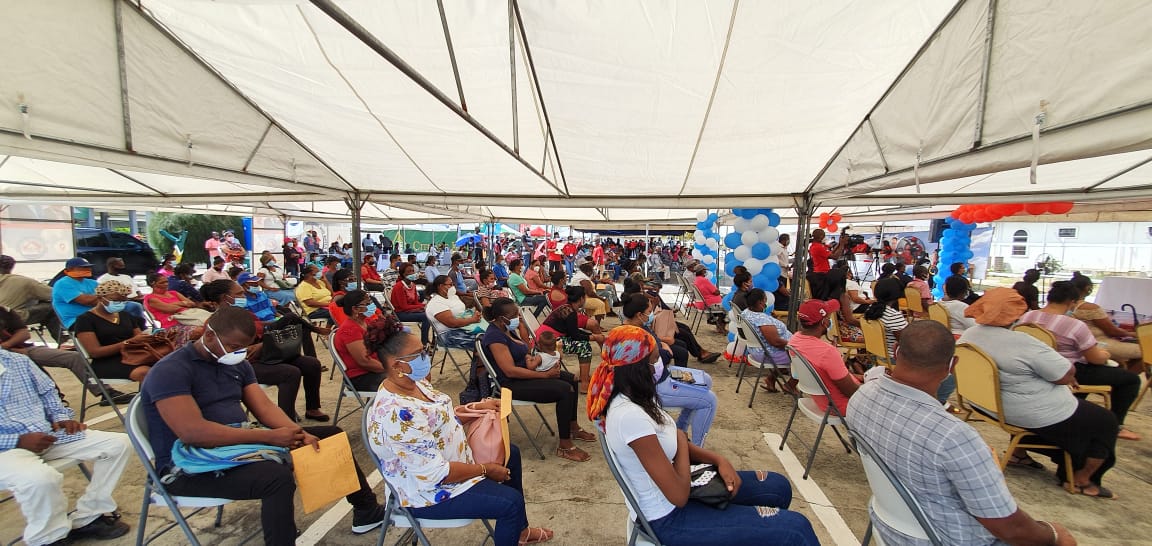
President David Granger as he addressed a political rally at Rosehall on Sunday
A consistent decline in the population of East Berbice-Corentyne (Region 6) is a direct result of the People’s Progressive Party (PPP) failing to fairly manage the affairs of that region. That was according to incumbent President David Granger who made his re-election pitch to thousands of supporters and residents of that county in Rose Hall on Sunday.
“We have a big problem in Region six and the problem is the PPP. People are running away from this region even though there is a PPP RDC [Regional Democratic Council] and majority PPP NDCs [Neighbourhood Democratic Councils]” he posited.
To support his claim, the President pointed to the fact that in 1991, under the People’s National Congress (PNC), the population of Region six was 142,000, but after the PPP took office in 1992, the population started to dwindle. He said that from 142,000 in 1991, the population was reduced to 123,000 in 2001, and then to 109,000 in 2012 under the Donald Ramotar-led government.
The Guyana Population and Housing Census 2012 confirm these figures and shows that even while the population of the region was declining at that time, between 1991 and 2002 the national population increased from 723,673 to 751,223. The population then dipped to 747,884 in 2012.
According to Granger, the confidence that the PPP once enjoyed in Region six ceases to exist, and the party can no longer claim the region as a stronghold.To convince the gathering, he referenced voting statistics which indicate that the PPP has consistently been losing votes in the region.
He noted that under the PPP’s Janet Jagan in 1997, the party won 52,000 votes. However, he noted that by 2001, it had been reduced to 47,000 votes. In 2006, that number tumbled further to 42,000 and reached in lowest – 32,000 – in 2011. In 2015 the PPP recovered and amassed 39,000 votes.
“You see what is happening to the PPP in region six? They thought they had a stronghold in region six. They put a strangle-hold and we are going to break that stranglehold on March 2, 2020” the incumbent shared.
Region Six, which depends heavily on sugar, has traditionally been a stronghold for the PPP which kept the industry alive even though it has been operating at a loss over the last few decades.
Since the closure of two estates in 2017 – Rose Hall and Skeldon – the fear of the PPP is that thousands of its supporters have migrated in search of new opportunities. And even though the party boasted a record turnout in Berbice at its Albion Rally last month, it appealed to those supporters to return home and vote on March 2.
“Call every one of your relatives back. Call them abroad and say come back home and vote, this is a once in a lifetime opportunity, it is freedom at stake here,” the party’s General Secretary Bharrat Jagdeo urged supporters.
But Granger remains fairly confident that Jagdeo will not be able to revive the PPP in region six since the decline in support for the party occurred under his stewardship of the country.
“Under Jagdeo, the PPP’s score in region six has been falling and it’s going to fall further next month. It is going to fall because the PPP is unwilling and unable to run this region fairly,” the President predicted.