19 Reg Six schools get water purification systems under FLOW program
September 12 2026
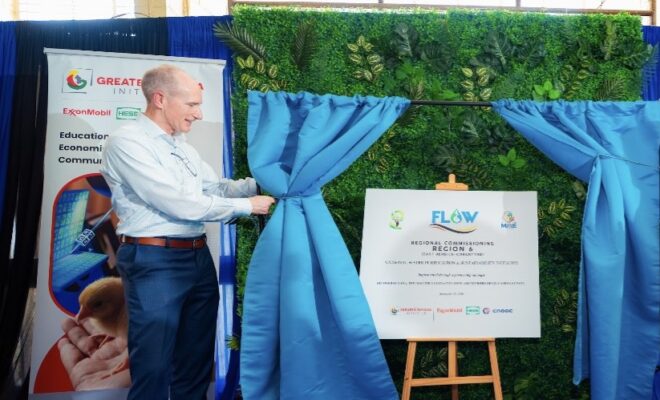
Nineteen public secondary schools and technical and vocational education and training (TVET) institutions in Region Six have received new water purification systems under a partnership between Recover Guyana, the Greater Guyana Initiative (GGI) and the Ministry of Education.
The systems, commissioned Friday at New Amsterdam Secondary School, are expected to provide approximately 9,602 students and educators with access to purified drinking water while saving an estimated $103.7 million in bottled-water costs and eliminating approximately 5.7 million single-use plastic bottles over three years.
The Region Six rollout forms part of FLOW, GGI’s signature project under the National Water Purification and Sustainability Initiative. It includes 17 secondary schools and two TVET institutions and represents the programme’s second regional rollout following its pilot at West Demerara Secondary School.
FLOW is a four-year initiative aimed at providing purified drinking water to more than 58,000 students at 141 public secondary schools, 10 TVET institutions and four special-needs schools by 2030.
The systems combine reverse osmosis, ultraviolet disinfection, solar power and smart monitoring technology, allowing schools to produce purified drinking water while tracking reductions in plastic waste. The project also exposes students to technologies related to water treatment, renewable energy and environmental monitoring, supporting STEM education.
Dr. Dave Lalltoo, FLOW lead and president of Recover Guyana, said the initiative demonstrates how education can extend beyond the classroom and produce lasting environmental benefits.
“As we celebrate Education Month, perhaps the greatest lesson FLOW can offer is this: education becomes most powerful when knowledge becomes action. When a student chooses to refill instead of discard, understands the science behind the water they drink, appreciates the value of renewable energy, or takes a message about conservation home to their family, education has already travelled beyond the classroom. That is how we move from classrooms to communities.”
Lalltoo also highlighted the recent accreditation of the FLOW laboratory under the GYS 170:2021 standard by the Guyana National Bureau of Standards, describing it as an important step in strengthening water-quality testing, assurance and public confidence.
Alistair Routledge, President of ExxonMobil Guyana, said FLOW goes beyond providing potable water by giving students an opportunity to understand and take ownership of the technology behind the systems.
The project has also created opportunities for local workers, with nearly 100 community members benefiting from activities including construction, plumbing, electrical work, solar installation, masonry, carpentry, welding and painting.
The environmental impact is already being recorded. Within its first five days of operation, the Region Six systems prevented the use of 16,318 single-use plastic bottles.
With Region Six and the West Demerara pilot completed, FLOW has now reached 35 sites nationwide, benefiting more than 18,000 people.
A further 22 sites are expected to be completed in Georgetown by the end of 2026, including 18 secondary schools and two special-needs institutions. Systems have already been installed at 11 Georgetown schools.
FLOW is ultimately targeting 155 educational institutions and the prevention of 25 million single-use plastic bottles by 2030, as the partners seek to combine improved access to drinking water with environmental awareness, STEM education and economic opportunities for Guyanese communities.