Venezuela’s claim a “long and threatening shadow” to Guyanese
May 8 2026
Guyana’s Attorney General and Minister of Legal Affairs Anil Nandlall, SC, on Friday urged the International Court of Justice (ICJ) to issue a clear and unequivocal ruling affirming the validity of the 1899 Arbitral Award, warning that any ambiguity could encourage Venezuela to continue claiming the majority of Guyana’s territory.
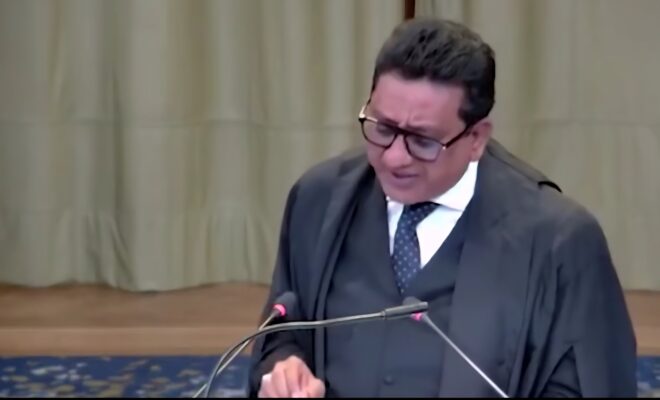
Nandlall delivered Guyana’s final presentation during the third day of public hearings at the Peace Palace in The Hague in the case concerning the validity of the 1899 Arbitral Award.
He described the proceedings as critical to Guyana’s sovereignty, territorial integrity and future.
Addressing the court, the Attorney General said Guyana has lived for generations under the threat of Venezuela’s claim to more than 70 per cent of its territory, arguing that the loss of the Essequibo region would fundamentally undermine the country’s existence.
He said Guyana’s decision to approach the ICJ in 2018 reflected its longstanding commitment to international law and the peaceful settlement of disputes. Nandlall maintained that international law remains essential to preserving global order and stable relations among states.
The Attorney General also accused Venezuela of repeatedly attempting to avoid a substantive ruling on the matter, despite previous ICJ decisions in 2020 and 2023 affirming the court’s jurisdiction to hear the case.
According to Nandlall, Guyana’s legal team has demonstrated that Venezuela’s challenges to both the 1897 Treaty of Washington and the 1899 Arbitral Award lack legal and historical merit. He argued that Venezuela willingly entered the 1897 agreement, which secured the arbitration process it had long sought.
He further contended that Venezuela’s allegations of fraud, procedural irregularities and inadequate reasoning do not invalidate the award, noting that Venezuela recognised and respected the ruling for more than 60 years before rejecting it in the 1960s.
Turning to Venezuela’s reliance on decolonisation arguments, Nandlall said the position was contradictory given what he described as Venezuela’s longstanding attempts to threaten Guyana’s territorial integrity since independence in 1966.
The Attorney General also challenged claims made by Venezuela regarding the history of the Essequibo region, including assertions surrounding the origin of the Essequibo River’s name, which he said was derived from an Indigenous word later adopted by Dutch and British settlers.
Nandlall stressed that the wording of the ICJ’s eventual judgement would be crucial in bringing finality to the controversy. He urged the court to directly and explicitly affirm the validity of the 1899 Arbitral Award and the boundary established by it, warning that any qualification or uncertainty in the ruling could be used by Venezuela to justify continuing its territorial claims against Guyana.
The hearings before the ICJ are scheduled to continue on Monday with Venezuela’s final presentation.