Venezuela peddling “mythological narrative”-Attorney Reichler
May 8 2026
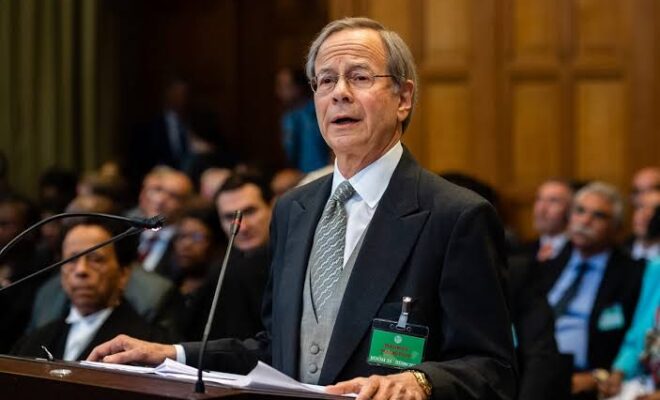
Guyana’s legal team on firmly rejected Venezuela’s arguments before the International Court of Justice (ICJ), with international attorney Paul Reichler describing Venezuela’s case as a distorted version of history aimed at justifying its claim to more than two-thirds of Guyana’s territory.
Presenting Guyana’s second round of oral pleadings during the third day of hearings at the Peace Palace in The Hague today, Reichler argued that Venezuela has attempted to portray itself as a victim of colonial injustice while ignoring what he said was its own role in obstructing Guyana’s path to independence and threatening the country’s sovereignty for decades.
Reichler told the court that Venezuela’s claims of conspiracy and fraud surrounding the 1897 Treaty of Washington and the 1899 Arbitral Award were unsupported by historical evidence.
He said Guyana’s earlier submissions, including documentary records, remain unchallenged and noted that Venezuela failed to produce contemporaneous evidence proving allegations of coercion or collusion.
According to Reichler, historical records instead show that Venezuela had actively pursued arbitration with Britain and sought the assistance of the United States in securing that process. He argued that Venezuelan officials at the time viewed the agreement as being in the country’s best interest and willingly accepted it.
He also rejected Venezuela’s claim that negotiations surrounding the 1897 treaty occurred without Venezuelan involvement, stating that records demonstrated Venezuelan representatives were consulted throughout the process.
Addressing Venezuela’s position on the 1966 Geneva Agreement, Reichler argued that the agreement did not invalidate or replace the 1899 Arbitral Award, as Venezuela now contends. He described Venezuela’s interpretation as a recent argument that only surfaced decades after the agreement was signed.
Reichler pointed to Article 5 of the Geneva Agreement, which he said preserved previously established territorial rights and claims, including those arising from the 1899 award. He further argued that Venezuela’s insistence that the award is “null and void” itself confirms that there is a legal dispute over the award’s validity — a matter properly before the ICJ.
Turning to Guyana’s independence era, Reichler rejected Venezuela’s portrayal of itself as a supporter of decolonisation, arguing that Venezuela revived its territorial claim in the 1960s at a time when Guyana was approaching independence and was politically vulnerable.
He maintained that Venezuela sought to exploit the situation to acquire the Essequibo region while Guyana was still a newly emerging state.
Reichler concluded by reaffirming Guyana’s position that the 1899 Arbitral Award remains legally valid and binding under international law, while indicating that Guyana’s team would make additional submissions concerning the 1905 Boundary Treaty between Venezuela and Great Britain.