CANU reports major gains in drug enforcement, regional cooperation in 2025
January 12 2025
The Customs Anti-Narcotic Unit (CANU) has outlined significant achievements in its 2025 operational overview, highlighting strengthened enforcement, expanded prevention programmes, and enhanced regional and international cooperation as Guyana continues efforts to combat narcotics trafficking.
A major milestone for the year was the formal launch of Guyana’s National Early Warning System (EWS), which enhances the country’s ability to detect, assess and respond to new psychoactive substances and emerging drug threats.
The system integrates inputs from law enforcement, forensic, health and analytical agencies, supporting rapid alerts, evidence-based interventions and informed policy responses in line with regional and international best practices.
Throughout 2025, CANU intensified intelligence-led enforcement operations, targeting trafficking routes, organised criminal networks, and high-risk ports and border locations.
These efforts resulted in significant seizures, arrests and case development, reinforcing Guyana’s position as an active disruptor within regional trafficking networks rather than a passive transit point.
Inter-agency coordination was also strengthened during the year, with improved information sharing, joint operations and coordinated responses among key national stakeholders. CANU reported that this whole-of-government approach enhanced investigative outcomes and operational efficiency.
At the regional and international level, the Unit deepened cooperation with strategic partners through joint operations, intelligence exchanges, technical assistance and capacity-building initiatives.
These partnerships improved cross-border threat awareness and reinforced Guyana’s commitments under regional and global drug-control frameworks.
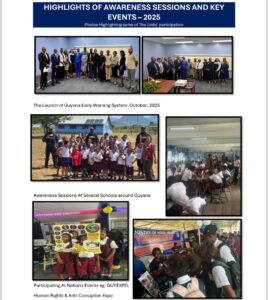
In the area of prevention and demand reduction, CANU expanded public awareness campaigns and prevention programmes, working closely with the Ministries of Education, Human Services and Social Security, and Home Affairs.
Continued support was also provided to the Drug Treatment Court, linking enforcement efforts with rehabilitation and social reintegration.
Seizures and Enforcement Results
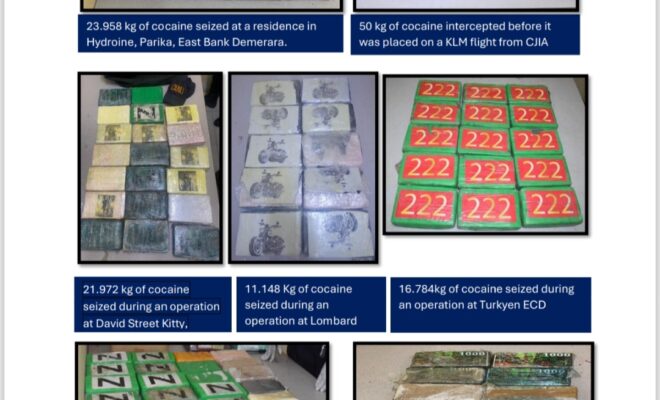
CANU reported the seizure of 235.9 kilograms of cocaine, 726.3 kilograms of cannabis, 674 grams of ecstasy, 83 grams of methamphetamine and 9.16 grams of cannabis products in 2025.
Cocaine and cannabis remained the dominant threats, accounting for the majority of trafficking attempts. Officials noted that the reduction in cocaine quantities compared to 2024 was influenced by an exceptionally large seizure made in Region One the previous year.
Region Four recorded the highest cocaine seizures at 172.8 kilograms, while Region Six accounted for the largest volume of cannabis seizures at 576 kilograms. Synthetic drugs appeared in smaller but increasing quantities, prompting continued monitoring through the Early Warning System.
A total of 117 arrests were made during the year, with 62 persons charged. Approximately 82 per cent of those arrested were male.
Arrests peaked in April, May, July and September. CANU also secured 29 drug-related convictions, including 14 for cocaine, 12 for cannabis and three involving synthetic drugs and cannabis products. Fines reached as high as GYD $311 million, with prison sentences of up to four years depending on the quantity and intent to traffic.
The estimated street value of narcotics seized in 2025 was placed at GYD $433.9 million, with cocaine accounting for $235.9 million and cannabis $197.7 million. Together, these substances represented more than 99 per cent of the total estimated value.
Firearms, Prevention and Capacity Building
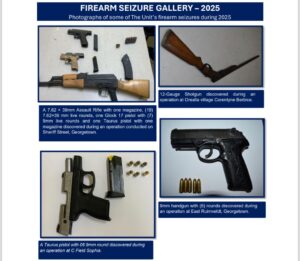
CANU also reported the seizure of 13 firearms during the year, most commonly 9mm pistols, with half of the recovered weapons directly linked to narcotics trafficking operations. Although ammunition seizures declined by 62 per cent, officials noted continued overlap between drug and firearm networks.
In prevention and public awareness efforts, CANU reached 5,678 beneficiaries nationwide through school-based programmes, youth engagements, community outreach, and interventions targeting vulnerable and special-needs groups. More than 86 per cent of outreach activities took place in schools.
The Unit further strengthened its capacity through 27 local and international training programmes supported by partners including UNODC, REDTRAC, CICAD/OAS, CBSA, French Special Operations, Colombian authorities, Singapore SCP and national agencies. Training focused on areas such as crime scene processing, intelligence analysis, digital forensics, firearms proficiency, maritime security and cybersecurity.
CANU concluded that it enters 2026 with enhanced intelligence tools, expanded partnerships and improved operational readiness, positioning Guyana to counter evolving trafficking methods and emerging synthetic drug threats.