75 Countries Impacted as U.S. Suspends Visas; 10 from CARICOM
January 14, 2026
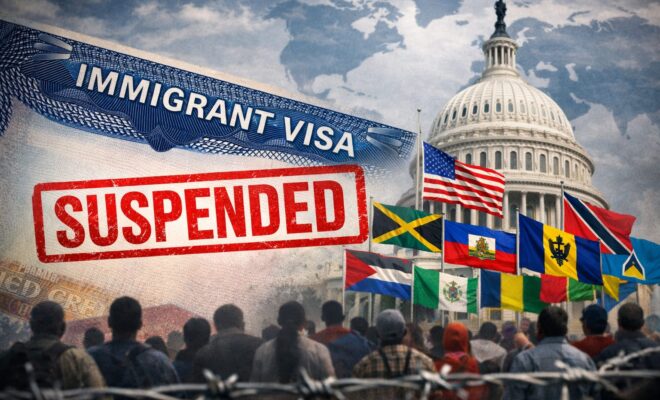
The U.S. State Department announced today that it will suspend the processing of immigrant visas for citizens of 75 countries, including 10 members of the Caribbean Community (CARICOM), effective January 21, 2026.
The policy, driven by concerns that applicants from these nations may rely on public assistance after entering the United States, marks one of the most sweeping shifts in U.S. immigration policy in recent years and is expected to affect thousands of prospective immigrants worldwide.
Under the directive, consular officers at U.S. embassies and consulates will halt immigrant visa adjudications for nationals of the identified countries while the State Department reassesses screening procedures and “public charge” criteria rules that allow U.S. authorities to deny visas to applicants deemed likely to become dependent on government benefits. Non-immigrant visas, such as tourist and business visas, are not included in this suspension.
In a department statement, Secretary of State Marco Rubio framed the pause as necessary to end “abuse of America’s immigration system by those who would extract wealth from the American people,” a sentiment consistent with broader immigration tightening under the current administration.
The suspension spans Africa, Asia, Europe, Latin America, and the Caribbean. Among the nations highlighted in public reporting are Afghanistan, Iran, Russia, Somalia, Brazil, Egypt, and Nigeria, alongside a cluster of smaller states across several regions.
According to compiled government data and reporting, the following CARICOM member states are included in the 75-country list:
Antigua and Barbuda
Bahamas
Barbados
Belize
Dominica
Grenada
Haiti
Jamaica
Saint Kitts and Nevis
Saint Lucia
Saint Vincent and the Grenadines
The inclusion of these Caribbean nations underscores the policy’s global reach and its potential to disrupt migration patterns from small island states where economic opportunities remain limited and diaspora connections to the United States are significant.
U.S. officials point to the “public charge” provision of immigration law as the statutory foundation for the suspension. Historically in place for decades, the public charge rule permits visa denial when applicants are determined likely to depend on U.S. public assistance programs. Critics of past administrations contended the rule was applied unevenly; the current policy codifies a stricter enforcement posture focused on financial self-sufficiency indicators, including age, health status, English proficiency, previous benefit use, and employment prospects.
The State Department’s guidance instructs consular officers to evaluate these factors comprehensively before issuing immigrant visas, a process it says will help prevent the entry of individuals who may pose long-term welfare burdens. The department has not specified how long the suspension will remain in effect or what specific metrics will be used to determine when visa processing might resume.
Groups have criticized the pause, arguing that it conflates economic necessity with public assistance dependency and may disproportionately affect low-income applicants and families seeking reunification. Legal experts also warn the policy could slow economic mobility for people from lower-income countries and strain diplomatic relations with affected states. Analysts predict that uncertainty surrounding visa backlogs may increase, particularly in regions with heavy demand for U.S. immigration pathways.
For CARICOM nations, where remittances and migration flows to the United States play a significant economic role, the suspension could have immediate social and economic impacts. Prospective immigrants and families awaiting visa interviews are urged to monitor official U.S. embassy communications for updates on processing status and any potential exceptions.
The suspension comes at a politically charged moment for U.S. immigration policy, with broader debates continuing domestically over border security, labor market needs, and humanitarian commitments. The State Department has indicated that further guidance and clarifications will be issued as the review process proceeds, though specific timelines remain unclear.
(Sources: AP News, CNN Network, WDRB, CNA, Reuters.)