Mahdia Teen Accused in Deadly Fire to Face High Court Trial
The court has ruled that the accused will stand trial for the murder of the 19 children who perished in the tragic Mahdia Dormitory fire.
The prosecution in the murder case against the secondary school student who allegedly set the Mahdia Dorm Fire has strongly opposed a no-case submission, asserting that sufficient evidence exists for the trial to continue.
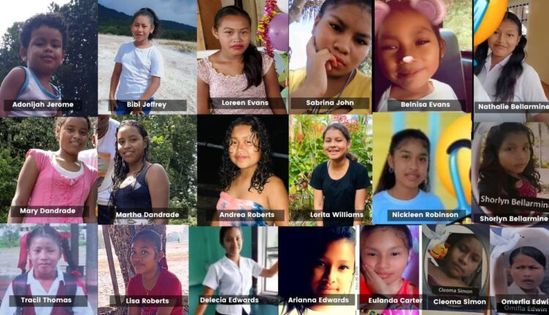
That fire claimed the lives of 18 girls and a 5-year-old boy. The names of the children who died are: Adonijah Jerome, Tracil Thomas, Lisa Roberts, Delecia Edwards, Lorita Williams, Natalie Bellarmine, Arriana Edwards, Cleoma Simon, Subrina John, Martha D’Andrade, (and twin) Mary D’Andrade, Belnisa Evans, Loreen Evans, Omerfia Edwin, Nickleen Robinson, Sherena Daniels, Eulanda Carter, Andrea Roberts, and Rita Jeffrey.
The student, who is represented by attorney-at-law Dexter Todd, is accused of deliberately igniting a deadly fire at the Mahdia Secondary School Female Dormitory, which resulted in the deaths of 20 children in May 2023.
Prosecution’s Argument
According to court documents, the prosecution, led by Special Prosecutor Latchmie Rahamat, emphasized that circumstantial evidence is legally sufficient to prove a case. They cited multiple legal precedents, including R v Nash (1911) and The State v Sookraj Evans (1975), which affirm that when circumstantial evidence is compelling enough to rule out other reasonable explanations, it can be used to establish guilt.
Testimonies from witnesses support the assertion that the minor deliberately set the fire. Statements from other dorm occupants indicated that the young lady was angered after her mobile phone was confiscated by the dorm supervisor and teacher. The minor then allegedly threatened to burn down the dormitory and was later seen with a yellow cigarette lighter and a bottle of perfume—both potential accelerants for the fire.
Legal Basis for the Submission Rejection
The prosecution referenced established legal precedents, including the English Practice Note (1962) and cases such as R v Galbraith (1981), to argue that a no-case submission should only be upheld if there is no evidence to prove an essential element of the crime or if the evidence presented is so weak or discredited that no reasonable jury could convict.
In this case, the prosecution maintains that both direct and circumstantial evidence provide a clear basis for the trial to proceed.
Details of the Incident
The Mahdia Secondary School Female Dormitory, housing 59 students, was a secured building with locked doors at night. On May 21, 2023, at approximately 11:00 PM, a fire broke out in the bathroom/toilet area, quickly engulfing the building.
Witnesses described how students frantically tried to escape, with some managing to break through doors, while others succumbed to smoke inhalation and burns.
Firefighters testified that by the time emergency responders arrived, the dormitory was already heavily ablaze. After extinguishing the fire, 14 bodies were initially recovered, with additional fatalities confirmed later.
Autopsies conducted by forensic pathologists confirmed the cause of death as smoke inhalation and burns.
Forensic Findings and Investigation
Investigators collected debris samples from the fire scene for analysis and obtained DNA samples to identify victims. According to the prosecution, the fire was intentionally set, and the circumstances leading up to the incident strongly implicated the accused.
Further, in an interview with police officers and a probation officer at Mahdia Hospital on May 23, 2023, the student provided a written statement after being informed of the allegations against her. However, details of her statement remain undisclosed.
Prosecution’s Conclusion
Based on the evidence, the prosecution argues that there is a clear case against the accused, making a no-case submission inappropriate.
They contend that the combination of witness testimonies, forensic analysis, and circumstantial evidence overwhelmingly points to her guilt.
The Accused is now committed to stand trial in the High Court for the offence of Murder committed on the 19 victims.