CoA refuses posthumous appeals in Bartica massacre
March 11 2026
-Resentences Michael Caesar & Celbert Reece to Life Imprisonment
The Guyana Court of Appeal on Wednesday delivered its ruling in the long-running appeals stemming from the 2008 Bartica massacre, declining to allow the posthumous appeals of two convicted men while resentencing the remaining appellants to life imprisonment.
The decision was delivered by Justice of Appeal Jo-Ann Barlow, one of three judges on the panel, alongside Justices of Appeal Dawn Gregory and Rishi Persaud.
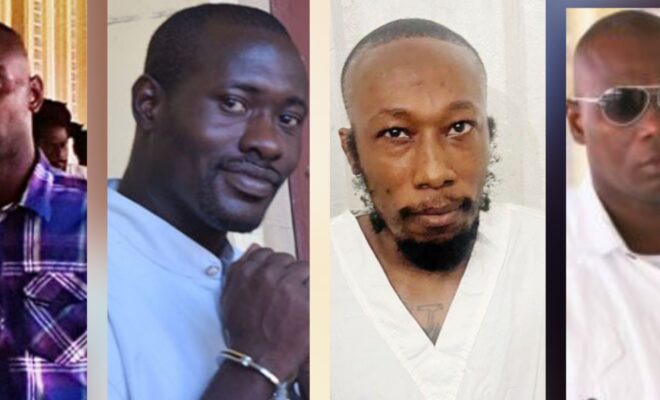
The appeals involved four men convicted in connection with the deadly attacks on the mining town of Bartica and the village of Lusignan earlier in 2008: Mark Royden Williams, Dennis Williams, Celbert Reece, and Michael Caesar.
In considering the cases of Mark Royden Williams and Dennis Williams, the appellate court examined whether their appeals could continue after their deaths.
Mark Royden Williams had been convicted of eight counts of murder, while Dennis Williams was found guilty of seven counts of murder and five counts of manslaughter.
Both men were sentenced to death on the murder convictions and to life imprisonment for the manslaughter offences. Dennis Williams died while in prison custody, whereas Mark Royden Williams was shot and killed by law enforcement after escaping from the Mazaruni Prison.
The court noted that under Guyanese law, the right to appeal is a personal act that does not survive the death of an appellant.
While Commonwealth jurisdictions allow a court to exercise discretion to continue appeals posthumously in exceptional circumstances, the judges concluded that this case did not warrant such discretion.
The court also considered the appeals of Michael Caesar and Celbert Reece, both of whom had pleaded guilty to manslaughter. Caesar was convicted on 12 counts relating to the Bartica massacre and eight counts connected to Lusignan.
At trial, Caesar received lengthy prison terms: 45 years for each Lusignan count after deductions for time served, guilty plea, and mitigating factors, and 60 years for each Bartica count following similar deductions.
All sentences were ordered to run concurrently, with a minimum of 40 years to be served before parole eligibility.
The Court of Appeal found that these determinate sentences effectively exceeded life imprisonment and therefore could not stand.
Caesar was resentenced to life imprisonment for both massacres, with 38 years to be served before eligibility for parole for Lusignan—reduced by eight years for time spent on remand, leaving 30 years—and 40 years to be served for Bartica.
The sentences for both massacres are to run concurrently, effective from December 8, 2016, the date of his original High Court sentencing.
Celbert Reece, originally sentenced to 35 years for manslaughter, was also resentenced to life imprisonment for each of the 12 counts relating to Bartica.
Taking into account his efforts at rehabilitation while in prison, the court set his parole eligibility at 34 years, deducting eight years for time spent on remand, resulting in a final period of 26 years before parole consideration.
The sentences will run from November 18, 2016, the date on which he was sentenced in the High Court.
The attacks themselves remain some of the most notorious in Guyana’s history.
The Lusignan massacre on January 26, 2008, left 11 residents dead, including children, at the hands of a gang led by Rondell “Fineman” Rawlins.
Less than a month later, Rawlins and his group carried out the Bartica massacre, killing 12 people—including three police officers—before Rawlins and several gang members were later killed by security forces.

In Bartica, the gunmen arrived by speedboat, killed three police officers at the police station, moved through the town firing on civilians, and stormed CBR Mining to seize cash, gold, and weapons, leaving a trail of devastation.