Health concerns delay Mohameds extradition case

February 19 2026
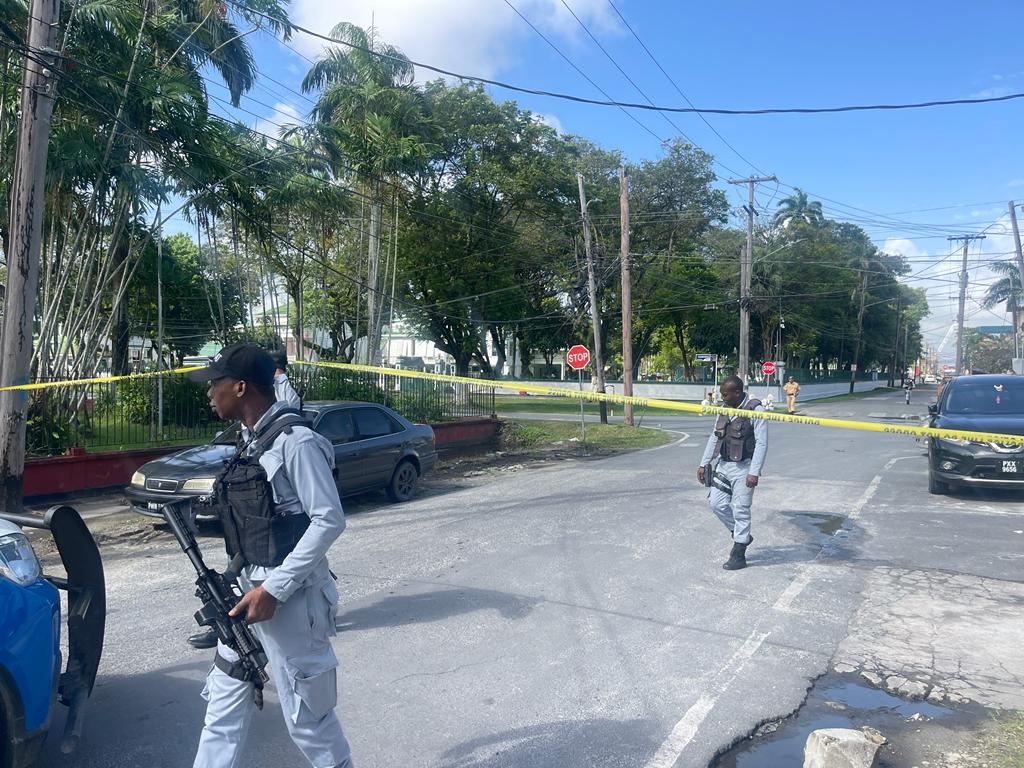
The ongoing extradition proceedings involving businessman Nazar Mohamed and his son, Opposition Leader Azruddin Mohamed, were once again adjourned on Wednesday at the Georgetown Magistrates’ Court, where Principal Magistrate Judy Latchman presides.
The case, now stretching over three months, has been closely monitored due to its high-profile nature.
When the matter was previously called on February 9, the court postponed proceedings to February 16 after being informed that Nazar Mohamed was unwell.
During the February 16 session, an arrest warrant was temporarily issued for Azruddin Mohamed after he failed to appear at the scheduled 9:00h session.
The warrant was later withdrawn after the defence provided an explanation. Nazar Mohamed did not attend that session due to health concerns.
On Wednesday, both father and son were present, though no updated medical documentation for Nazar Mohamed was submitted.
Defence attorneys explained that the elder Mohamed’s cardiologist is on leave and that his recovery remains incomplete, prompting the court to set the next hearing for February 26 to allow additional medical evidence to be prepared.
The session also featured a significant legal debate regarding the method of proceeding with the extradition.
The prosecution proposed that the case move forward via paper committal instead of the traditional Preliminary Inquiry (PI).
This suggestion was initially put forward by Attorney Glenn Hanoman and supported by lead prosecutor, Jamaican Attorney-at-Law Terrence Williams, KC.
The defence strongly opposed the proposal, arguing that the Fugitive Offenders (Amendment Act) Act does not permit extradition cases to bypass the Preliminary Inquiry process.
Attorney Siand Dhurjon emphasized that such a move would deny the defendants the right to test evidence through oral cross-examination. “
The prosecution is asking the Magistrate not to take any further oral evidence but just to admit all of the documents and decide whether or not to extradite the defendants without any question being asked from a single witness.
This is indisputable evidence that the prosecution is scattered now,” Dhurjon said outside the courtroom.
Senior Counsel Roysdale Forde, representing the Mohameds, clarified that the Criminal Law Procedure (Paper Committal) Act 2024 applies solely to local criminal offences and cannot be applied to extradition proceedings.
He noted that bypassing cross-examination would strip the defendants of a fundamental part of the Preliminary Inquiry process.
“There is no basis in law at this stage for the court to even apply the paper committal. They are two different regimes; two different processes would have been enacted in the two different acts. In relation to the Criminal Law Offences Act, which basically deals with indictable offences, it contemplates ultimately a trial in the High Court in the local country, which is Guyana. In relation to the Fugitive Offenders Act, it contemplates a preliminary enquiry and if a case is made out for extradition abroad,” Forde explained.
Magistrate Latchman questioned the prosecution on the legal basis for applying the paper committal approach. She highlighted that extradition cases under the Fugitive Offenders Act are distinct from indictable offences and require a Preliminary Inquiry to ensure procedural fairness.
“What would be the criminal offence in this matter? That’s one… and paper committal applies where there is a criminal offence. When a magistrate conducts a paper committal, there is absolutely no cross-examination,” she noted.
The prosecution maintained that in extradition cases, evidence is primarily tested by the requesting state.
Prosecutor Williams argued that cross-examination is not strictly required, though Guyana could also review the evidence. The court directed the prosecution to submit written arguments on the paper committal proposal by February 26.
During the hearing, Nazar Mohamed spoke on his ongoing health challenges, reporting chest tightness, difficulty breathing, cramps in his arms and legs, and elevated blood pressure.
Defence counsel highlighted the extraordinary effort he made to attend despite his discomfort and the absence of an updated medical report. “I’m really not well… tightness in my chest, breathing problems, but the cramps are under control, and the pressure is still up… I’m just here because the counsel told me I have to come,” he told the court.
Also present in the courtroom was Attorney-at-Law Charrandass Persaud, former High Commissioner to India.
Persaud was seated with the defence team and later offered his observations outside the court.
“Our judicial system in this country is royally in a mess. And that needs to be fixed. So, for now, I will only leave it at that. I am not on the legal team for the Mohameds though. I’ve known the Mohameds for years. And when I listen to what’s going on, or what went on in the court, and what has been going on, what is going on, I just thought I’d come here and get a first-hand view of what is going on. So, we’ve heard, and I’ll tell you this now, we’ve heard from the prosecution,” Persaud said.
He further criticized the prosecution’s handling of the case, suggesting inconsistencies in their approach.
“These are hired lawyers. People hired by our government to prosecute our Guyanese. That they are now considering people committed in the extradition proceeding. They’re the ones who brought witnesses. If you follow the case initially, and they said they have more witnesses to come, and now you want people committed, they’re dreaming. They’re going on the spur of the moment.”
Persaud is also noted for his role in Guyanese politics, having voted against his own government in a no-confidence motion on 21 December 2018. His vote helped the opposition secure a 33–32 majority in the National Assembly, leading to the collapse of the APNU‑AFC coalition government and triggering early elections.
Nazar, 72, and Azruddin Mohamed, 38, are being pursued under the Guyana–United Kingdom Extradition Treaty, as retained under Section 4(1)(a) of the Fugitive Offenders Act, Cap. 10:04, updated by Act No. 10 of 2024. The United States formally submitted its extradition request on October 30, 2025.
The father-son duo, along with their business interests, were sanctioned by the US Treasury Department’s Office of Foreign Assets Control (OFAC) on June 11, 2024, over allegations of large-scale corruption, including gold smuggling, money laundering, and bribery.
Investigations indicate attempts to evade over US$50 million in taxes owed to the Guyanese government.
A grand jury in the US District Court for the Southern District of Florida has indicted Nazar and Azruddin Mohamed on 11 counts, including wire fraud, mail fraud, and money laundering, primarily linked to the export of gold by Mohamed’s Enterprises to the United States.
Convictions on most charges carry maximum penalties of 20 years imprisonment and fines up to US$250,000, while the money laundering charge carries a potential fine of US$500,000 or the value of laundered assets.
Both defendants remain out on bail of $150,000 each as the extradition process continues, having surrendered their passports. They are also required to report weekly to Ruimveldt Police Station.
The next hearing is scheduled for February 26, 2026, from 9:00h to 15:00h.