Venezuela’s referendum: ICJ to rule Friday on Guyana’s request for provisional measures
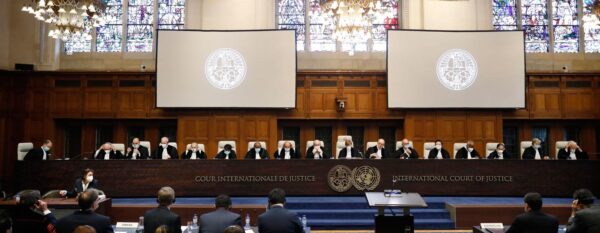
The International Court of Justice (ICJ), situated in The Hague, has announced that it will issue its order on Friday, December 1, 2023, on Guyana’s application for interim remedies against Venezuela’s December 3, 2023, referendum that aims to annex Guyana’s Essequibo county.
The order will be read by the court’s President, Judge Joan E. Donoghue.
Guyana requested on Wednesday, November 15, 2023, that the top court of the United Nations (UN) impose temporary measures to halt voting on certain questions in the referendum because it views it as an “existential threat” that would enable Venezuela to take Essequibo.
Venezuela, on the other hand, asserts that Guyana’s request for provisional measures undermines the historical, internal, and constitutional affairs of that nation.
In its application before the World Court, Guyana contends that the referendum is to obtain responses that would support Venezuela’s decision to abandon legal proceedings, and to resort instead to unilateral measures to “resolve” the border controversy with Guyana.
Venezuela’s Vice President Delcy Rodríguez has already declared that nothing—not even the ICJ—can prevent her country’s planned referendum.
On October 3, 1899, 122 years ago, the Anglo-Venezuelan Arbitral Tribunal met in Paris, France, and rendered a decision that established the boundary between Venezuela and what was then British Guiana.
Following over 50 years of adherence to the 1899 Arbitral Award, Venezuela asserted its territorial claims to the Essequibo region of Guyana in 1962.
Since 2015, when ExxonMobil discovered oil in Essequibo, the issue has become more intense.
To resolve the border controversy, the UN Secretary-General carried out Good Offices procedures between 1990 and 2017 within the parameters of the 1966 Geneva Agreement between the two nations.
Following a thorough examination of events in 2017, then Secretary-General Antonio Guterres referred the controversy to the ICJ for settlement.
In order to confirm that the border was established in an arbitration between Venezuela and British Guiana in 1899, Guyana filed a World Court case against Venezuela in 2018.
In the case, Guyana seeks, among other things, to obtain from the ICJ a final and binding judgement that the 1899 Arbitral Award, which established the location of the land boundary between then-British Guiana and Venezuela, remains valid and binding; and a declaration that Essequibo belongs to Guyana.
A final ruling in the significant case might not be made for years.
The ICJ determined in April 2023 that it had jurisdiction to resolve the long-running border controversy between the South American neighbours. However, Venezuela has continuously rejected the ICJ’s jurisdiction to adjudicate over the matter.
The Essequibo region accounts for almost two-thirds of Guyana’s territory, with around 125,000 of the country’s 800,000 inhabitants living there.