Essequibo dispute escalates ahead of ICJ hearing
April 30 2026
Diplomatic tensions between Guyana and Venezuela have intensified following remarks by Venezuelan officials defending their country’s claim to the disputed Essequibo region, even as both nations prepare for upcoming hearings at the International Court of Justice (ICJ).
Speaking on Tuesday at an anti-sanctions rally in Valencia, Carabobo state, Venezuela’s acting President Delcy Rodríguez reaffirmed her country’s longstanding position on the territory, citing international law and the 1966 Geneva Agreement as the basis for its claim. She indicated that Venezuela is preparing to present its case before the ICJ in the coming days, describing the process as both legal and symbolic for the nation.
Rodríguez also addressed criticism from Guyana regarding her recent public appearances wearing a brooch depicting Venezuela’s map, which includes the Essequibo region. She dismissed the concerns, stating that it represents “the only map” she has ever known and criticized what she described as undue attention to her attire.
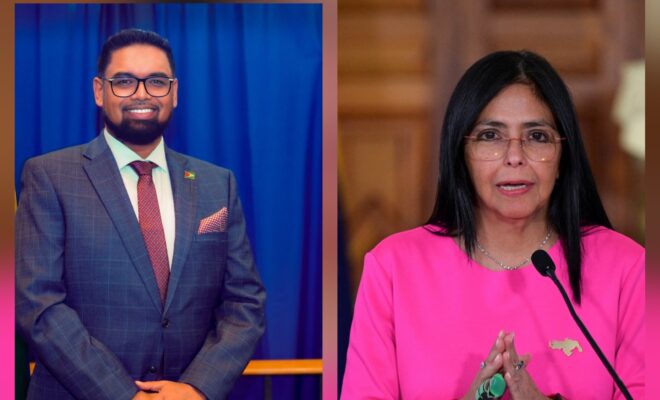
Her comments came in response to a formal complaint lodged by the Government of Guyana to Caribbean leaders. President of Guyana Dr Irfaan Ali raised concerns after Rodríguez wore the controversial brooch during official visits to Barbados and Grenada, arguing that the symbol asserts Venezuela’s claim over Guyana’s territory.
The Essequibo region, which comprises roughly two-thirds of Guyana’s landmass and is rich in natural resources, remains at the center of a centuries-old territorial dispute between the two South American neighbours.
Guyana has consistently maintained that the matter should be resolved through international law. In 2018, it brought the case before the ICJ, seeking validation of the 1899 Arbitral Award that established the current border. Oral hearings are scheduled to begin on May 4, marking a critical phase in the legal process toward a binding resolution.
Meanwhile, senior Venezuelan officials have continued to defend their country’s position. National Assembly President Jorge Rodríguez stated that Venezuela’s claim to what it calls “Guayana Esequiba” is rooted in historical, legal, and moral grounds, emphasizing a commitment to diplomacy while maintaining sovereignty.
Venezuelan Foreign Minister Yván Gil also criticized Guyana’s response, asserting that Venezuela’s territorial rights cannot be undermined by diplomatic protests. He described Guyana’s objections as excessive and accused President Ali of attempting to distract from the broader legal issues at stake.
The escalating rhetoric underscores growing regional sensitivity ahead of the ICJ hearings, which are widely viewed as a pivotal moment in determining the future of the disputed territory.