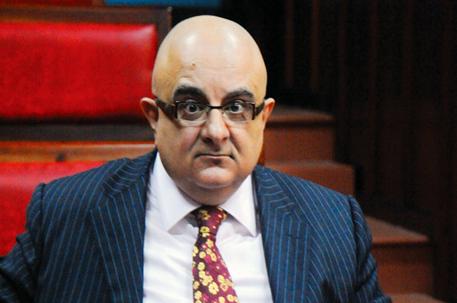
Nandlall Rejects FGM claims, Says Electoral System is Lawful and Fair
August 26 2025
Attorney General and Minister of Legal Affairs Anil Nandlall, SC, on Tuesday robustly defended Guyana’s proportional representation (PR) electoral system, dismissing the Forward Guyana Movement’s (FGM) legal challenge as “perhaps the most misconceived, one of all the challenges that have been made against the system.”
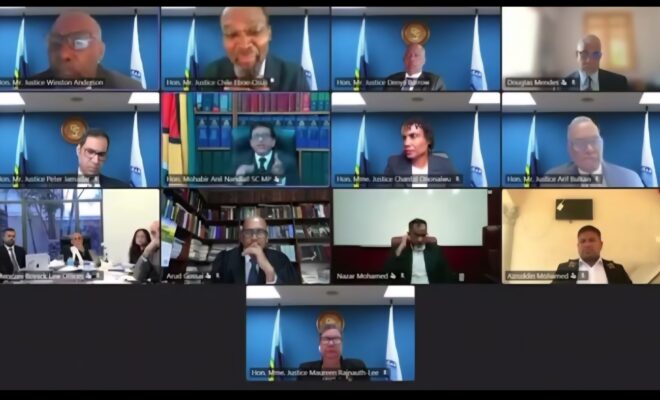
The comments came shortly after he presented arguments before Chief Justice (ag) Navindra Singh at the Demerara High Court, in a case seeking to block the September 1 General and Regional Elections unless FGM’s candidates are included on ballots in all 10 administrative regions.
FGM, through candidate Krystal Hadassah Fisher, filed the case last week, arguing that its exclusion from Regions Seven, Eight, and Nine, where it is not contesting Regional Democratic Council (RDC) seats, violates constitutional guarantees of equal suffrage and proportional representation.
Attorney Dr Vivian Williams, representing FGM, contended that GECOM’s practice of excluding parties from regions where they are not contesting RDC seats is discriminatory and undermines democratic inclusion. The challenge also cited the omission of Assembly for Liberty and Prosperity (ALP) ballots in Regions One, Two, Eight, and Nine.
In outlining his arguments, Nandlall emphasized the historical development of Guyana’s electoral system, explaining that it evolved from the first-past-the-post model before independence, to proportional representation, regional elections in 1980, and the introduction of geographic constituencies in 2001.
“There was a distinct impression, I believe, conveyed, that our system is somehow flawed and somehow denies registered electors the right to vote. And I feel that that’s completely wrong,” he said.
He further explained that each elector casts two votes: one in a geographic constituency and another for RDCs, with votes in geographic constituencies also contributing to the national “top-up” list. “If you don’t have a vote in the geographic constituency, then you don’t have a vote in the national top-up,” Nandlall clarified.
He stressed that of the 65 parliamentary seats, 25 are drawn directly from geographic constituencies, while 40 are allocated from the national top-up list.
Rejecting claims that Amerindians in Regions Seven, Eight, and Nine would be disenfranchised, Nandlall stated that citizens “will vote—they will just not vote for a party that is not contesting in those regions.”
He argued that it is the applicant party, by choosing not to contest, that limits voter choice. “It is the party, in my view, that is discriminating against two-thirds of Guyana. It’s not the other way around,” he said. Concluding his presentation, he affirmed, “The case is without merit.”
GECOM lawyer Arudranauth Gossai echoed Nandlall’s points, stressing that the Commission has acted within the law and that FGM’s claims reflect a misunderstanding of legislative requirements.
He explained that under Section 11(b) subsection 2 of the Representation of the People Act (RoPA), political parties must submit candidate lists for each geographic constituency, noting that FGM had not done so for certain regions.
He added that the presidential candidate is elected from the national “top-up” list, which depends on votes from geographic constituencies.
“So, if a party chooses not to contest geographic constituencies, it does not receive a vote for the national ‘top-up’ list. The national ‘top-up’ list is not independent; it depends on the geographic list,” Gossai said, comparing the situation to “FGM choosing the basic Zoom package but expecting GECOM to place it on the premium package.”
Dr Vivian Williams argued that GECOM’s application of ROPA is inconsistent with the Constitution. He stated, “RoPA is, in my humble opinion, not inconsistent with the Constitution. What is inconsistent with the Constitution is GECOM’s application of ROPA.”
FGM is composed of three political entities: Forward Guyana (FG), The People’s Movement (TPM), and the Vigilant Political Action Committee (V-PAC).
The case resumes on Wednesday with further arguments from FGM, while Justice Singh has indicated his intention to deliver a ruling before the week’s end.