Hearing on motion to expedite election petition case set for Oct. 3
In June 2021, Claudette Thorne and Heston Bostwick filed an appeal against a ruling by Chief Justice (ag) Roxane George, SC to dismiss an election petition they filed on behalf of the APNU+AFC challenging the results of the March 2020 General and Regional Elections.
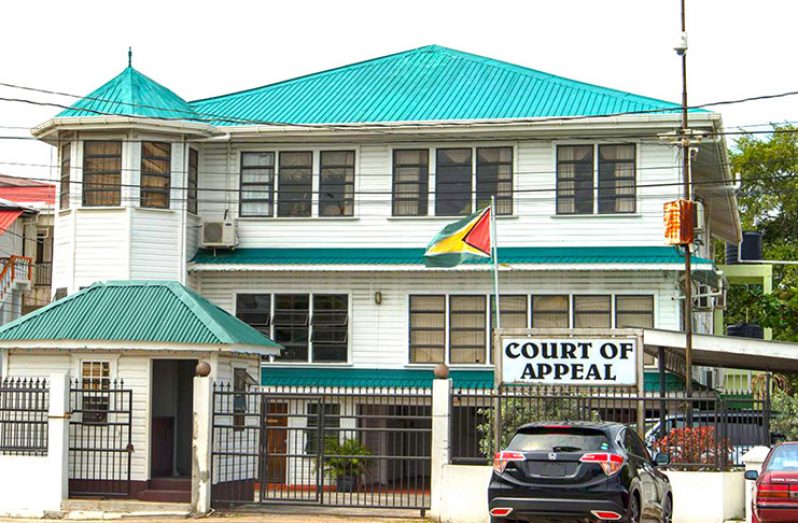
But more than a year later, the Court of Appeal of Guyana is yet to hear the petitioners’ appeal. As such, Senior Counsel Roysdale Forde, on their behalf on August 30, filed a motion at the appellate court, requesting that the hearing of the petition be expedited.
The Court of Appeal of Guyana will convene a hearing on this motion on October 3 via Zoom.
Shortly after GECOM declared the elections results on August 2, 2020, the party filed this petition seeking to invalidate the elections results which showed a win for the PPP/C on the grounds of serious non-compliance with the Constitution of Guyana and electoral laws.
But in April 2021, the Chief Justice, in dismissing the party’s petition, declared that GECOM acted in full compliance with the Constitution and electoral laws in its conduct of the polls.
Thorne and Bostwick had argued that Section 22 of the Election Laws (Amendment) Act (ELA) and Order #60 of 2020, otherwise known as the Recount Order, are unconstitutional; thus, resulting in breaches and violations by GECOM in its conduct of those elections.
The Recount Order was created by GECOM pursuant to Section 22 of the ELA and Article 162 of the Constitution to facilitate the recount of all ballots cast in the March 2020 General and Regional Election.
The intent of Order #60 was to resolve irregularities, discrepancies, and anomalies occurring in the elections process and to determine a final credible count.
Justice George in her ruling held that neither Section 22 of the ELA or Order #60 are ultra vires of the Constitution.
The Chief Justice said, “My analysis of the authorities cited has led me to the ineluctable conclusion that Section 22 is not ultra vires of the Constitution. And I hold, there has been no violation of the doctrine of separation of powers.”
“Section 22 is meant as an aid to the process to permit a determination of a result. It does not permit usurpation of the High Court’s jurisdiction under Article 163 [of the Constitution] at all. Section 22 provides the parametres for its efficacy, and the power granted therein is not arbitrary.
“It includes sufficient mechanisms to establish that Parliament did not surrender or abdicate its powers. Thus, I hold that there was a lawful delegation of power as provided for in Section 22 so that GECOM could independently and properly control the election process…”
According to her, the power set out in Section 22 is clearly and sufficiently circumscribed to not run afoul the doctrine of the separation of powers.
She held, too, that the conditionalities of delegated legislation which are evident in Section 22 are that (a) it authorizes only the making of subsidiary legislation, in this case, Order #60 and (b) the power is only applicable when it appears to (GECOM) necessary or expedient for removing any difficulty.
“…(c) once Parliament is in session the Order must be subject to a negative resolution of the National Assembly (d) the order cannot be made after three months of the expiration of an election and (d) the only time this power is without supervisory jurisdiction of Parliament is when Parliament is not in session, and that time is limited to three months from the date of the election,” the acting Chief Justice had outlined in her judgement.
In upholding the constitutionality of Order #60, she said “…it is not ultra vires the Constitution or Section 22. A combination of Article 162 (1) (b) and Section 22 conferred a power on GECOM to issue this Order if GECOM considered it necessary or expedient to ensure impartiality, fairness, and compliance on part of persons exercising powers or performing duties on its behalf as regards to the election process and the declaration of the results of the election.”
The Chief Justice, therefore, underscored that a recount of votes is not alien to the election process, adding that GECOM has to be in control of the election process until it is satisfactorily completed.
“This is the ultimate power that GECOM has pursuant to Article 162. Thus, Order #60 does not confer any additional powers on GECOM, but simply alter the procedure to arrive at the result that the Representation of the People Act requires. While the procedure [in this case] was different, the aim and objective were the same. That is, to count the ballots and determine the votes cast for the list of the political parties who contested the elections.”
Having regards to the foregoing, she dismissed the election petition. Justice George had also ordered that the Statements of Poll (SoPs) and Statements of Recount (SoRs), which were handed over to the Supreme Court of Judicature by GECOM, are to remain in the custody of the court’s Registrar until the petitioners have exhausted all their right of appeal.
The Chief Justice has dismissed all election petitions filed on behalf of APNU+AFC challenging the results of the March 2020 General and Regional Elections.
The other petition filed by Brennan Nurse and Monica Thomas was dismissed in January 2021, for non-compliance with effecting service on the second-named respondent, former President David Granger.
In a consolidated appeal at the Caribbean Court of Justice (CCJ), Attorney General and Legal Affairs Minister Anil Nandlall, SC and Vice President Dr Bharrat Jagdeo, have appealed against the judgment of the Court of Appeal of Guyana delivered in December 2021.
In this judgment, the majority held that the Court of Appeal has jurisdiction to entertain an appeal from the decision of Justice George in relation to the petition filed by Nurse and Thomas.
Jagdeo and Nandlall, however, contend that the court erred in law and had no jurisdiction to hear and determine the appeal; neither from statute, the Constitution nor does it have an inherent jurisdiction.
Ultimately, the Attorney General and Vice President are asking the CCJ– Guyana’s court of last resort– to set aside the appeal court’s ruling. The CCJ heard the matter in July and has reserved its decision.