Bench revolt at CCJ: Judges accuse President Anderson of “dictatorial” overreach
August 9 2026
Confidential email exchanges surfaced over the weekend by the Trinidad Express showing a near-unanimous judicial revolt against CCJ President Justice Winston Anderson.
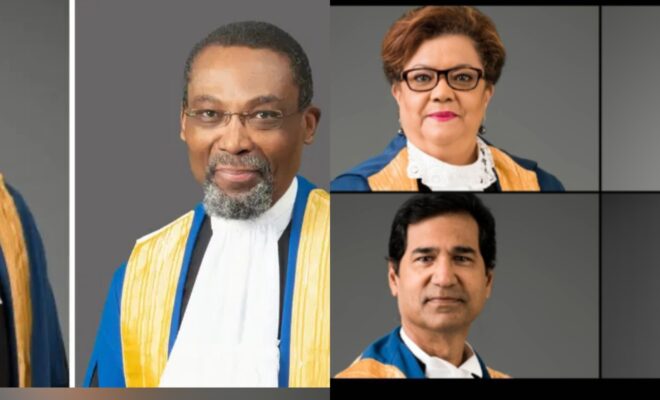
Five of the court’s six sitting judges, Justices Chile Eboe-Osuji, Chantal Ononaiwu, Arif Bulkan, Maureen Rajnauth-Lee, and Peter Jamadar, have condemned Justice Anderson’s management style, leveling grave allegations of “dictatorial” leadership, administrative overreach, panel fixing, and attempts to improperly sway decisions in high-stakes matters, including the extradition proceeding Mohamed v MOHA.
The disclosure has triggered an official statement from the Office of the Leader of the Opposition and rebukes from Opposition MP Sherod Duncan, APNU Parliamentary Lead Terrence Campbell, WPA Co-Leader Dr. David Hinds.
All have expressed concern that internal dysfunction at the region’s highest judicial body seriously undermines public trust in its impartiality, particularly regarding sensitive Guyanese litigation.
The dispute broke into the open over a June 2026 administrative disagreement regarding a proposed judicial dress code that judges claim was unilaterally forwarded to the Regional Judicial Legal Services Commission (RJLSC) without prior internal deliberation.
In the leaked correspondence, Justice Chile Eboe-Osuji directly characterized the administration as a “dictatorship,” recalling that shortly after assuming his post in July 2025, Justice Anderson “told us early on in a judges’ meeting… that he did not see himself as ‘running a democracy’ and that he would run the court in any way that he deems fit.”
Eboe-Osuji warned against using organs like the RJLSC as “an unwitting instrument of dictatorship,” cautioning that the escalating “level of disenchantment that may well be approaching a crisis point if left unaddressed.”
Beyond disputes over governance, the correspondence contains allegations of direct interference in active proceedings. Detail-rich emails from Justice Peter Jamadar outline what he characterized as a toxic work culture and outright judicial overreach during the Mohamed vs MOHA, AG, and Magistrate extradition matter: “what I experienced as an attempt to influence the opinions of colleagues that differed from yours in an authoritative manner” Jamadar noted that his experiences under Anderson’s tenure were “increasingly becoming toxic” and went “far beyond anything that I have ever experienced in all my years as a judicial officer sitting on appellate courts.”
Reinforcing these claims, Justice Eboe-Osuji noted that in Barrow v Caricom, Justice Anderson “tried single-handedly to override judicial independence and long-standing CCJ conventions that guided how decisions are rendered when judges disagreed,” while in the Mohamed case, Anderson attempted to “announce a decision of the court at a time and in a manner in which a clear majority of his colleagues had very strongly communicated to him as inappropriate.”
Warning of broader systemic threats to the rule of law across both the Original and Appellate divisions, Justice Jamadar stressed:
“emerging or creeping patterns of anti-democratic approaches to us as judges of the court in matters that directly and indirectly impact our core functions”
“A threat to the administration of justice”
“My integrity, independence, and impartiality as a judge of the CCJ are paramount”
“Contrary to my judicial oath to abide by any imposition of rules, regulations, or practices that may unreasonably and/or disproportionately undermine these principles.”
CCJ’s Defense
Attempting to stem escalating public anxiety, the CCJ released a statement defending its institutional integrity, urging against external speculation without complete context.
The regional tribunal noted that “The Court is mindful that questions and allegations presented without the benefit of context, background, or an appreciation of the nature of judicial deliberations, collegial discussions, and institutional governance may lend themselves to misunderstanding or mischaracterisation.”
Reaffirming its founding mandate of February 14, 2001, the Court reminded the public that it functions effectively as “two courts in one” serving as the sole interpreter of the Revised Treaty of Chaguaramas for 12 CARICOM states while acting as the final court of appeal for member states that have acceded to its appellate jurisdiction.
The tribunal further reaffirmed its adherence to the UN Bangalore Principles of Judicial Conduct, asserting that the bench remains bound by “independence, impartiality, integrity, propriety, equality, competence, and diligence.”
It concluded by emphasizing that “Maintaining public confidence in the Court is fundamental to upholding the rule of law and preserving trust in the administration of justice,” remaining committed to delivering “accessible fair and efficient justice for the people and states of the Caribbean Community.”
Earlier today, the Office of the Leader of the Opposition issued a statement calling for an independent inquiry:
“These concerns do not come from a lone or dissenting voice within the Court,” the statement emphasized. “The people of Guyana and the wider Caribbean are entitled to know precisely what occurred during the deliberations in the Mohamed extradition matter… Judicial independence cannot merely be proclaimed. It must exist in practice, it must be protected internally, and the public must be able to see that it has been protected.”
Writing on his Facebook page, APNU Parliamentary Lead Terrence Campbell stated: “I am a firm believer in the CCJ. However, I have had cause to worry about the independence of Justice Anderson. This newspaper article now adds to my angst.”
Opposition MP Sherod Duncan noted that long-held assumptions regarding the tribunal’s immunity to political pressure must be reassessed, urging the CCJ to issue a full, transparent statement on whether paneling or administrative disputes compromised any rulings.
WPA Co-Leader Dr. David Hinds remarked that while it is premature to arrive at final conclusions, “this does not look good.” Highlighting the CCJ’s historic role in determining crucial Guyanese political outcomes, Dr. Hinds questioned: “Are the current allegations confined to the present leadership or are they broader and deeper?”
The leaked communications follow prior scrutiny surrounding Justice Anderson’s direct interactions with Guyanese political figures.
In October 2025, then-APNU Leader Aubrey Norton disclosed that Justice Anderson had contacted him directly regarding the substantive appointment of then-Chancellor of the Judiciary, Yonette Cummings—an interaction Norton viewed as inappropriate involvement in an executive-opposition matter.
Speaking at a press conference following an October 15, 2025, courtesy call hosted by the PNCR and APNU to discuss judicial reform, Norton voiced severe reservations:
“I will never see them in the same light that I saw them at the inception of its establishment…All I would say to you is that I was engaged by him. I give him my views on the situation…and outside of that, I know of no other role that he would have played.”
When asked whether the engagement damaged the court’s standing, Norton drew parallels to prior election disputes:
“What I would say, as a party, we were in the forefront of pushing for the CCJ. But when actions like these and some that occurred during the election, it raises questions about the credibility of the CCJ in terms of dealing with Guyana in a fair way without political partisan involvement.”
Suspecting the outreach may have originated at the behest of the executive, Norton remarked: “I would be hard-pressed to say I know. But I will be, it would be reasonable to say I suspect so.” Norton explained that he terminated the dialogue upon realizing it conflicted with his position against judicial supersession: “I made it very clear in that meeting that I’m opposed to supersession of any kind, including superseding Cummings… I made the assumption that he knows my position in supersession. And therefore, he was engaging in that context, and fortunately, it wasn’t, and I ended it.”
Norton concluded that failure to grasp Guyana’s unique governance structure invited legitimate public skepticism: “In Guyana’s case, it is a kind of an authoritarian government that does not subscribe to the conventions of Westminster. And therefore, to the extent that they don’t seem to grasp that, some of their decisions would be questioned… I would say to you that this last set of engagement raised serious concerns about the impartiality of the Caribbean Court of Justice.”