Guyana: Venezuela’s claim “without basis”
May 4 2026
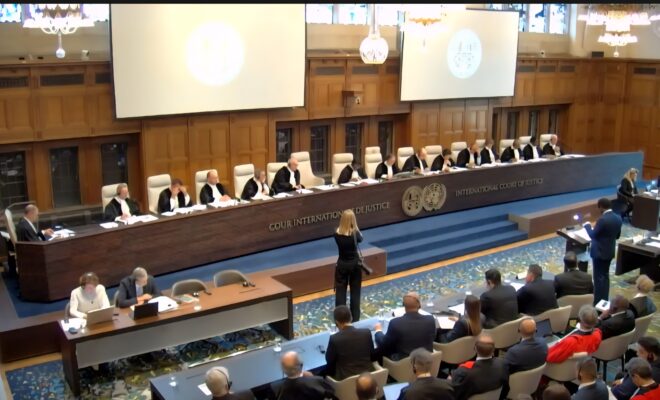
Guyana’s legal team on Monday mounted a strong defence before the International Court of Justice (ICJ), firmly rejecting Venezuela’s jurisdictional objections and upholding the validity of the 1899 Arbitral Award.
During oral hearings in the Essequibo border case, Professor Pierre d’Argent argued that Venezuela’s continued challenges to the court’s authority are unfounded and already settled.
He told the court that Venezuela’s position reflects a “misreading” of the 1966 Geneva Agreement and insisted that “Venezuela should not be allowed to revisit issues already decided by this Court.”
He pointed to prior rulings in 2020 and 2023, which confirmed the court’s jurisdiction and allowed the case to proceed to the current stage, where the validity of the 1899 Award is being examined.
Also representing Guyana, international attorney Paul Reichler defended the 1897 Treaty of Washington, which underpinned the arbitration process that determined the boundary.

Paul Reichler
Reichler dismissed Venezuela’s attempt to invalidate the Award, telling the court that the claim is “entirely without basis” in both law and fact. He noted that Venezuela ratified the treaty, participated in the arbitration, and accepted the outcome for more than 60 years before raising objections.
Addressing claims that Venezuela was excluded from negotiations, Reichler said historical evidence tells a different story. “The documentary evidence completely refutes any suggestion of exclusion or collusion,” he stated, outlining Venezuela’s active role in shaping the agreement.
Guyana’s team maintained that there is no legal justification to overturn either the treaty or the Award, arguing that the boundary established more than a century ago remains final and binding.
The hearings form part of ongoing proceedings to determine the validity of the 1899 Arbitral Award and the legal boundary between Guyana and Venezuela.