Special Branch boss admits coordinating with US Marshal; denies burning pocket book over missing notes
September 29 2026
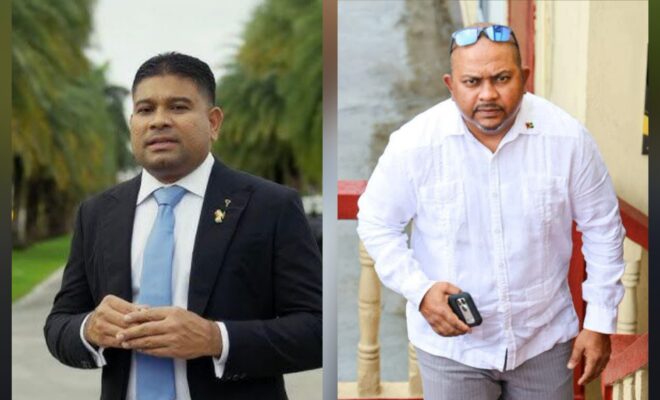
Head of the Guyana Police Force (GPF) Special Branch, Assistant Commissioner Prem Narine, on Tuesday admitted during intense cross-examination that he coordinated directly with United States Marshal Sandy Rao to execute the arrests of businessman Nazar Mohamed and his son, Leader of the Opposition Azruddin Mohamed, amidst ongoing extradition proceedings.
Narine’s disclosure came during the continuation of his cross-examination before Chief Magistrate Judy Latchman today in the Georgetown Magistrates’ Court, where defense attorneys Siand Dhurjon and Roysdale Forde, SC, probed the circumstances surrounding the October 31, 2025 arrest of the father-son duo. The Mohameds are wanted by the United States government to face trial on federal charges of wire fraud, mail fraud, and money laundering.
Defense counsel Siand Dhurjon questioned the senior officer over missing contemporaneous notes taken during the interception of Azruddin Mohamed. Under Standing Order 28(4)(f), police ranks are required to record statements and occurrences verbatim in their official pocket books.
Dhurjon put to the Special Branch chief that Azruddin had explicitly requested not to be placed in the open tray of a police pickup and had later complained that his handcuffs were cutting into his wrists. Narine repeatedly responded that he could not recall the specific exchanges, maintaining that it was impracticable to write while navigating a moving operational vehicle.
“I was unable to write in a moving vehicle, that is why I only jotted the time,” Narine testified.
Counsel then directly posited that the reason the officer could not recall what was said was because he had destroyed his official pocket book to cover up procedural breaches and excessive force.
“I am putting to you that the reason you cannot remember what was said and not said is because you shredded and burnt the pocket book in which you are obligated to record the statements of Azruddin Mohamed,” Dhurjon argued.
“That is not true,” Narine replied, denying that suggested motive for his memory lapse.
The court heard exchanges regarding the maneuvers used by police ranks on October 31, 2025, to intercept Azruddin’s Toyota Crown (PZZ 5000) near the corner of Princess and Smythe Streets.
Dhurjon argued that Narine, in his “unbridled eagerness to arrest the presumptive leader of the opposition,” created a threat to public safety through violent driving maneuvers.
State Prosecutor Herbert Mackenzie objected to the line of questioning, arguing that the witness was not charged with any traffic infractions and that emergency law enforcement vehicles are legally permitted to breach standard traffic regulations while executing arrest warrants. The presiding Magistrate sustained the prosecution’s objections, deeming questions regarding the public ruckus, traffic maneuvers, and alleged phone seizures from bystanders as irrelevant to the extradition threshold.
Counsel further argued that handcuffing the younger Mohamed behind his back so tightly that it broke the skin constituted a breach of fundamental human rights and amounted to cruel and inhumane treatment during a “lightning arrest.”
US MARSHAL & DIPLOMATIC COORDINATION
Under further cross-examination by Roysdale Forde, SC, Assistant Commissioner Narine detailed his interactions with foreign law enforcement personnel attached to the case, specifically US Marshal Sandy Rao.
Narine revealed to the court that on the morning of October 31, 2025, following a visit to the Attorney General’s Chambers, he received a phone call from Rao. According to Narine, Rao identified himself as the US Marshal assigned to the extradition matter.
“I asked him if he wants to accompany us through the process, and I believe he would have said yes that’s why I picked him up [at the Kingston Marriott Hotel],” Narine explained, adding that he had previously been introduced to Rao at the US Embassy by a Regional Security Officer (RSO) and was shown Rao’s official credentials and badge.
Narine acknowledged that he and Rao coordinated on the matter to facilitate the extradition, but flatly rejected allegations by both defense lawyers that he was working at the political behest of the ruling People’s Progressive Party (PPP) government out of personal allegiance or malice towards the businessmen. When put to him by Dhurjon that Azruddin Mohamed posed a political threat to the PPP administration, Narine countered from the witness box: “I don’t agree with that suggestion. Azruddin Mohamed is a threat to the people of this country.”
CONSTITUTIONAL FIAT AND SURVEILLANCE
Senior Counsel Forde focused his cross-examination on procedural compliance and document authentication, pressing Narine on whether a formal authorization, a fiat, was issued by the Director of Public Prosecutions (DPP) prior to the commencement of extradition arrest proceedings. Narine confirmed that no DPP fiat was tendered in his evidence.
When asked if he had ever gone to the Attorney General’s Chambers to collect or draft arrest warrants in his 26 years as a police officer, Narine testified that while he has visited the AG’s Chambers many times for various official matters, he could not recall specific instances regarding draft warrants.
Narine further confirmed to the court that the Mohameds were placed under active Special Branch surveillance prior to their arrest, stating that the operation was initiated under his direction following authorization from the Commissioner of Police.
The cross-examination of Assistant Commissioner Narine by Defense Counsel Dhurjon concluded on Tuesday afternoon. The extradition hearing continues before the Georgetown Magistrates’ Court on 21st October, 2026.