Commissioner, Safety Director clash over MARAD staffing
November 12 2026
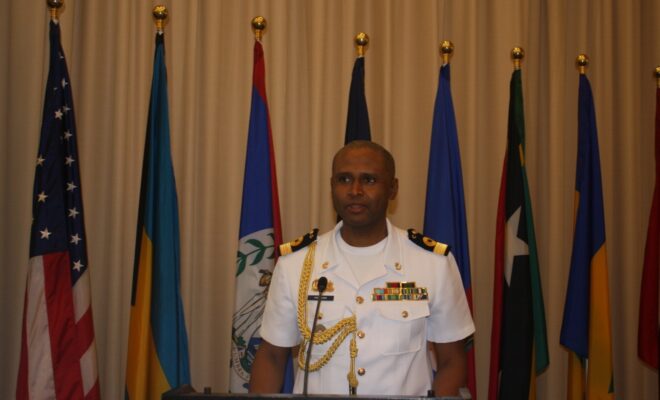
Commissioner Pritchard has warned that the Maritime Administration Department (MARAD) risks plunging into a “massive deficit” and an operational crisis if it fails to establish an optimal staffing baseline for marine inspectors, pushing back against assertions by Director of Maritime Safety Courtney McDonald that the agency’s current complement of nine inspectors is sufficient for Guyana’s rapidly expanding maritime sector.
Speaking during the Commission of Inquiry (CoI) into the sinking and capsizing of the MV Barima, Commissioner Pritchard challenged McDonald’s testimony that there is no fixed standard or target figure governing the size of MARAD’s inspectorate.
Drawing on his background in organizational development, the Commissioner stressed that while no rigid number can account for every eventuality, a regulatory body must calculate an optimal staffing level, factoring in budget constraints and training lead times, to prevent regulatory collapse.
“While I agree that there is no absolute number that we can agree on, to me, and I have a bit of experience in organizational development, you must determine what’s the optimal level that you must have on staff. Because if you go below that level, you could end up with something bordering on a crisis,” Commissioner Pritchard cautioned during the exchange.
He noted that waiting until staffing levels drop too low while fleet traffic continues to expand leaves the regulator exposed, particularly because marine officers cannot be deployed immediately without extensive training. “For instance, if the number is extremely low now and you have a growing fleet that requires your support, you have a massive deficit. When you marry that with the fact that you have to develop officers, you end up in a situation where MARAD is incapable in the short term or even in the medium term to deal with the challenges that it meets,” Commissioner Pritchard told the witness.
“So I’m not speaking about any fixed number to deal with all eventualities. I’m saying in your structure, you have to cater for all those factors. So I must say I disagree with you,” he added.
In response, McDonald defended MARAD’s reactive staffing model, maintaining that there is no established benchmark dictating how many inspectors the department must retain at any given time. Instead, he testified that management adjusts its recruitment based on real-time observations of industry growth.
“To the best of my knowledge, there’s no fixed figure to say, well, the inspectorate must have 20 inspectors, must have 15 inspectors. There’s no fixed figure. We decide on the figure based upon what we observe,” McDonald said. “If the marine department or the industry is expanding, then we recognize, well, hey, we need to have more inspectors. Hence the reason why we have eight marine officers currently training to be inspectors.”
Despite Commissioner Pritchard’s skepticism over whether nine active inspectors can adequately police Guyana’s busy waterways, McDonald insisted that the department is currently meeting its statutory obligations without backlogs.
“I would not say we’re facing challenges in Guyana regarding inspection. We do not have a lot of outstanding inspections. If you have outstanding inspections, we say, well, look, the inspectors cannot meet the requirements to inspect vessels. Vessels are being inspected on time,” the Maritime Safety Director stated.
Pressed directly by Commissioner Pritchard on whether he genuinely considers the nine inspectors currently on staff sufficient to handle present conditions in Guyana, McDonald stood firm, replying, “Yes, I do.”