Rodríguez revives Essequibo claim at UN
September 24 2026
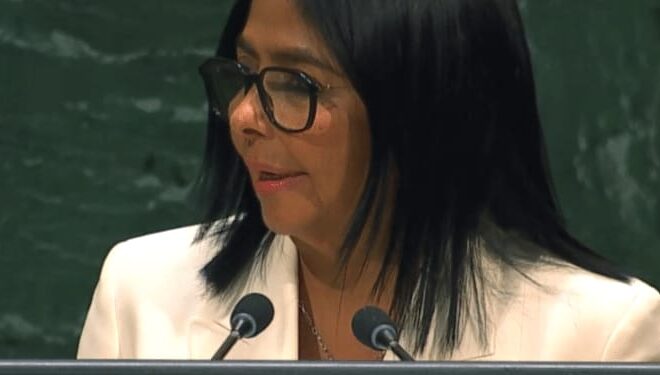
Venezuela’s acting President Delcy Rodríguez has used her address to the 81st United Nations General Assembly to reaffirm Caracas’ longstanding claim to Guyana’s Essequibo region, while calling for the two countries to return to direct negotiations over the decades-old territorial dispute.
Speaking in New York on Wednesday, Rodríguez said Venezuela was reaffirming what she described as its “historical rights” over the Guayana Esequiba and appealed to Guyana to resume negotiations under the 1966 Geneva Agreement.
Rodríguez argued that agreements reached through bilateral negotiations are more durable than settlements imposed through external institutions. Her remarks represent her first major statement on the Essequibo dispute before the UN General Assembly since assuming Venezuela’s acting presidency earlier this year.
The Essequibo dispute dates back more than a century. Venezuela rejects the 1899 Arbitral Award that established the land boundary between Venezuela and British Guiana, while Guyana maintains that the award definitively settled the border.
The dispute is currently before the International Court of Justice (ICJ), following a process under the 1966 Geneva Agreement. Guyana has participated in the ICJ proceedings, while Venezuela has maintained that the Court lacks jurisdiction to determine the controversy.
In May, during the final oral hearings in the case, Rodríguez reiterated Venezuela’s position that the country would not accept an ICJ ruling that it believes contradicts the Geneva Agreement.
Guyana, meanwhile, has said it remains committed to the ICJ process. The Guyanese government announced in June that the parties had completed their submissions and that the case was awaiting the Court’s final judgment. Guyana said the decision would be legally binding on both countries.
The ICJ has previously issued provisional measures concerning the dispute. In December 2023, the Court ordered Venezuela to refrain from taking actions intended to prepare for or allow the exercise of sovereignty or de facto control over territory awarded to British Guiana in the 1899 Award, and instructed Venezuela not to aggravate or extend the dispute.
Despite the disagreement over the Court’s role, Guyana and Venezuela previously committed to avoiding the use of force and to resolving their differences peacefully. Their December 2023 Argyle Declaration also referenced the Geneva Agreement and recognized the differing positions of the two governments regarding the ICJ.
Rodríguez’s latest appeal therefore places renewed emphasis on diplomatic negotiations as Venezuela continues to challenge Guyana’s position on the Essequibo. At the same time, the ICJ proceedings remain the principal international legal process through which Guyana is seeking a definitive resolution to the land-border controversy.
The timing of Rodríguez’s remarks is significant, as the ICJ is now considering its final judgment following the conclusion of oral hearings in May. Guyana said in June that, based on the Court’s usual timetable, a ruling could be expected between November 2026 and January 2027, although the Court has not announced a specific date.
For Guyana and Venezuela, the dispute remains one of the most consequential territorial issues in the region, with the outcome carrying implications for sovereignty, international law, diplomacy and the management of natural resources in and around the disputed area.